

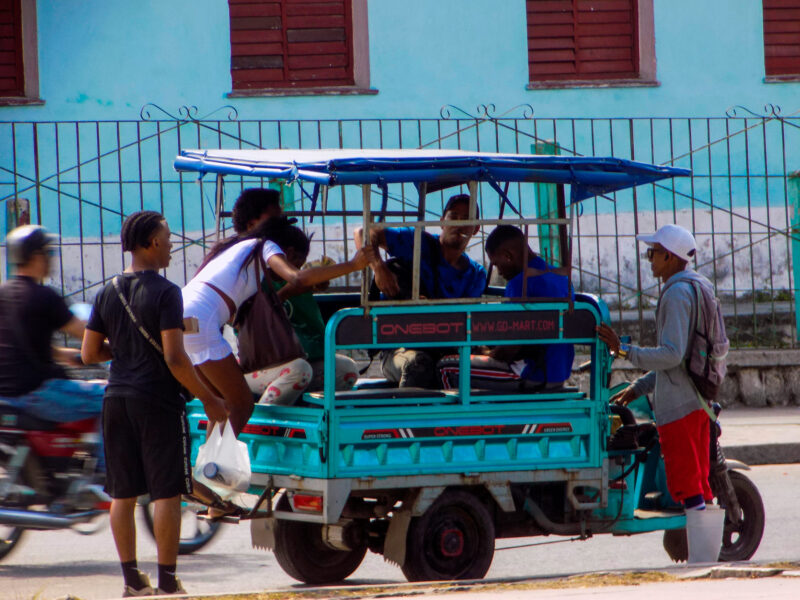
Photo Feature by Idania Cardenas
HAVANA TIMES — Lined up on any given street corner in the city, electric tricycles wait for passengers. Their presence is no longer surprising. They are part of Cuba’s urban landscape and, for many, the only real alternative to get to work, school, or the hospital.
But behind their efficient appearance lies a more complex phenomenon: the gradual shift of urban transportation from the state sphere to the individual pocket.
How Much Does It Cost to Get Around by Tricycle?
Although fares may vary depending on the municipality, distance, and time of day, an average trip within the city ranges between:
- 200 to 300 pesos for short routes (2–3 km)
- 300 to 500 pesos for medium distances or peripheral areas
By comparison, state bus transportation maintains a symbolic fare of just a few pesos in national currency, but with highly irregular frequency that forces many to opt for private alternatives.
Taking as reference an average monthly state salary of around 4,000 to 6,000 pesos (8 to 12 USD), a worker who uses a tricycle twice a day could spend between: 8,000 and 12,000 pesos per month — that is, the equivalent of one or even two full salaries on transportation alone.
For retirees or workers with lower incomes, the impact is even greater.
Voices from the Street
Martha Rodríguez, 62, retiree:
“It’s not a luxury, it’s a necessity. I can’t wait two hours or more for a bus. If I have a medical appointment, I have to take the tricycle. It costs me 250 pesos to the polyclinic. If I go and come back, that’s 500 in one day. That’s a lot for me, but I have no choice.”
Martha receives a pension that barely covers basic food. Transportation is an expense she must plan carefully.
Glenda Lopez, 34, tricycle driver:
“It’s my livelihood, but it’s not as easy as it looks. People think we make a lot of money, but the tricycle cost more than US $3,000. The batteries are expensive and don’t last long if there are many blackouts. Plus, I have to pay for a license and maintenance. If I don’t work one day, I earn nothing.”
Glenda explains that on a “good” day she can gross between 6,000 and 8,000 pesos (12 to 16 USD), but from that she deducts electric charging, parts, repairs, and tax contributions.
Daniel, university student:
“It’s faster, but it keeps getting more expensive. To get to the university I have to combine rides. If I take two tricycles, I spend almost 600 pesos a day. Sometimes I share with friends to split the cost, but it’s still expensive.”
For many young people, transportation represents a significant portion of the family budget.
A Market That Regulates Urgency
During peak hours — mornings and late afternoons — fares may increase informally. Although prices are guided by local authorities, regulation in practice is flexible and depends on supply and demand.
This behavior reveals a silent transformation: urban mobility increasingly operates under market logic.
Social Impact and Inequality
The rise of electric tricycles has generated employment and energized small businesses linked to their maintenance. However, it has also deepened differences: those who can pay move; those who cannot, wait.
In a context where transportation was historically conceived as a universal public service, the expansion of these vehicles raises a structural question:
Is this a temporary solution to the crisis, or the new permanent model of urban mobility?
More Than Transportation, a Social Indicator
The everyday scene of tricycles lined up on every corner speaks not only of popular innovation. It speaks of forced adaptation. It speaks of citizens who find solutions in the face of structural inefficiency.
Electric tricycles are not simply the most popular means of transportation in Cuba today; they reflect an ongoing economic and social transition, where urgency becomes business and mobility ceases to be guaranteed and instead becomes a matter of purchasing power.
See more photo features here on Havana Times.