
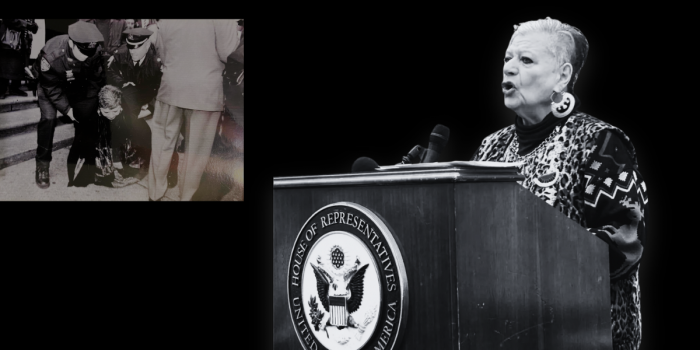
After recounting cruel torture

Nieves Ayress was 25 years old when the DINA (Chilean secret police) detained and tortured her. Expelled from Chile in 1976, she rebuilt her life in the South Bronx, where she has spent nearly four decades organizing communities. On February 10, she brought her testimony to the US Congress, denouncing complicity in her torture.
By Thiare Francisca Riquelme Gonzalez (El Mostrador)
HAVANA TIMES – On Tuesday, February 10, Luz de las Nieves Ayress Moreno stood before a microphone in the United States Congress. Behind her hung a red curtain. In front of her sat members of Congress and journalists. She had been introduced in English, but before beginning she clarified: “I am going to speak in Spanish, my language.” Her appearance came at the invitation of the progressive wing of the Democratic Party seeking for the US to move beyond the Monroe Doctrine.
She did not seem nervous. “I never doubted it, because I have always spoken out,” she said afterward.
“I was kidnapped along with my father, Carlos, and my younger brother, Tato, by Pinochet’s DINA intelligence services, who carried out a coup d’état in 1973 backed by the United States against the democratically elected government of President Salvador Allende within the framework of Operation Condor,” she began without hesitation.
Ayress then listed, without softening details, the torture she endured. “They applied electric current all over my body and on the most sensitive parts. I was raped many times.” She also said they forced her into sexual contact with her father and brother, cut her breasts and abdomen with military blades, applied alcohol and electricity to open wounds, cut off her ears, shaved her head, and inserted rats into her body.
The interpreter stopped. She could not find equivalent words. Another interpreter had to be called.
“These tortures were carried out by military personnel under Manuel Contreras, head of the DINA. And they were learned here, in the School of the Americas, in the United States,” she said. Then she raised the accusation: “I blame the US government of Nixon and Kissinger for helping Chile’s military dictatorship with weapons, instructions, and money. This is part of the Monroe Doctrine that all US presidents have applied. We call for it to be annulled. We are all Americans. Only the people save the people,” she concluded.
When she finished, Congresswoman Nydia Velazquez stood beside the podium in silence, unsure what to say. She then approached and embraced her.
The Democratic Party invitation took place within the framework of a resolution promoted by Velazquez and backed by legislators such as Alexandria Ocasio-Cortez, Greg Casar, and Rashida Tlaib.
The resolution seeks to move beyond the Monroe Doctrine and replace it with a policy of “New Good Neighborliness” toward Latin America. Proclaimed in 1823 by then-President James Monroe, the doctrine established that any foreign interference in the Western Hemisphere would be considered a threat — a principle many say served to justify multiple US interventions in the region.
“The doctrine has always been in force. Now it is stronger with Trump, because he is the president who says and does things. The others never spoke — they just acted,” explains Nieves Ayress by phone from the United States.
She mentions intervention in Venezuela, threats toward Mexico and Panama, and the tightening of the blockade on Cuba. The resolution — with little chance of passing in a House controlled by Republicans — also proposes declassifying archives linked to coups backed by Washington and reviewing the use of unilateral sanctions.
In a phone conversation with El Mostrador, the human rights activist said some invitees did not attend out of fear. “There is a lot of fear. The immigration situation here is very difficult; there is persecution. Not everyone can go to Congress to speak.” She, however, has done so for decades. “From the belly of the beast — as I call the Bronx, where I live — I have always denounced the US government for its intervention in Chile.”
A Traumatic History
Luz de las Nieves Ayress Moreno was 25 when she was detained. On January 30, 1974, DINA agents came for her at her father’s factory. They then took her to her home in San Miguel, where they also arrested Carlos, her father, and Tato, her 15-year-old brother.

She was transferred through different clandestine detention centers: Londres 38, Tejas Verdes, and Tres y Cuatro Álamos. She was tortured in all of them. Sexual violence occurred in all of them.
At Londres 38 she received electric shocks on the most sensitive parts of her body. They applied the Brazilian torture method known as the “pau de arara.” Another method was “the telephone,” simultaneous blows to both ears until disorientation set in. At the same time, she was forced to listen to the torture of her father and brother.
Her mother, Virginia Moreno, then began a search that crossed borders. She sent letters to political authorities, church officials, and international organizations. At a time when the dictatorship denied the existence of the disappeared, Ayress’s name began circulating outside Chile.
“I believe it was in February 1974 when they took me to another prison in Tejas Verdes, where I was held incommunicado. This was another training site for torturers, and the memories I have are of absolute brutality,” she wrote in a letter delivered to former president Ricardo Lagos, where she gave testimony.
She described some of the most atrocious torture she experienced firsthand. “In April 1974, when I had been taken to the Women’s Prison on Vicuña Mackenna, run by an order of nuns, I realized I was pregnant,” she continued in the letter. She lost the pregnancy a few months later as a result of the torture, without receiving medical care.
Nieves remained detained for nearly four years in different clandestine centers. Before going into exile, from Tres Álamos, she managed to send a letter to Ines Figueroa, wife of painter Nemesio Antunez. That letter was read in 1975 at the First UN World Conference on Women in Mexico. It was the first public denunciation of the dictatorship’s crimes against women.
“I recognize the courage of my mother Virginia, who was one of the first women to denounce what happened during the dictatorship. Thanks to her and other women we are alive. She spent time in the concentration camps visiting my father, my brothers, and me,” she acknowledges.

The Peña of the Bronx
In December 1976, after nearly four years in detention centers, she was expelled from Chile along with 17 other political prisoners. The condition: they could never return.
Nearly four decades would pass before she could legally name what had been done to her. Only in 2014, together with three other survivors, did she file the first lawsuit in Chile for political sexual violence — a systematic mechanism directed at activist women that was not even typified in the criminal code.
In 1987 she arrived in the South Bronx with her partner Víctor. They had previously lived in San Diego and San Francisco, but pressure from immigration services forced them to move again. It was Víctor who made the deliberate calculation: “He looked for the poorest place, the most marginalized, the most abandoned by the system.”
The answer was the South Bronx
“When we arrived there was no hot water or heating. In the middle of winter, 20 degrees below zero. For four years no one had complained.”
Together with Víctor, she organized a rent strike. They deposited the money in a bank and called all the media outlets. They notified authorities they would not pay until the problem was fixed. Neighbors, bewildered, hung signs in the building: “The communists have arrived. The revolutionaries have arrived.”
In less than a week, the city fixed the heating and hot water.

“When they saw what we achieved, neighbors came asking us to teach them how to do the same in other buildings.” Thus the first rent strike in the South Bronx was organized. And from there, everything else began.
With her partner and daughter she founded La Peña del Bronx, a cultural center that over time became a movement: a space for undocumented migrants, Puerto Ricans, Garífunas, newly arrived Mexicans, sex workers, the gay movement, Puerto Rican independentists — a place for rituals, music, cooking, and above all organizing. The venue could hold up to 1,500 people; festivals in neighborhood parks drew up to 3,000.
Ayress recounts that community gardens had begun with the Puerto Rican community, which transformed abandoned lots into gardens growing tomatoes and flowers, recreating agricultural and cultural practices. When Mayor Rudy Giuliani tried to turn them into condominiums for outsiders, the neighborhood organized to defend them. “We consider them liberated territories,” says Nieves. “Because we fought to have them.”
Ten blocks from her home operated an incinerator that burned waste from 21 city hospitals. The South Bronx came to have one of the highest asthma rates in the country. The fight to close it lasted seven years: protests, arrests, freeway blockades along the elevated highway crossing the neighborhood.
“Everything little that exists here is the product of struggle. It wasn’t given for free or because we are from the South Bronx,” she says.
They fought for the Ruiz Belvís clinic pharmacy when it was slated to close; for Hostos Community College when Spanish-language courses were threatened; for Lincoln Hospital, the area’s only hospital, when closure loomed. “It’s a bad hospital, but it’s ours,” she says.
Today Nieves is part of Mott Haven History Keepers, a group of ten people chosen by the community as guardians of South Bronx history. Each has a role: photography, sports, gastronomy, history. She is responsible for the memory of La Peña and four decades of cultural work. Everything is digitized and deposited in the Bronx Library.

The Decision to Live in the United States
When asked why she lives in the United States and not Chile, Nieves Ayress is unfazed. “From here come the structural policies against our countries. And who protests when something happens in Chile, Uruguay, Paraguay? We do. We are where the problem is born.”
Today she is nearly 80. She speaks of internationalism like family. As a child she listened to poets and musicians in Santiago’s parks; her mother took her to political events, where she met important cultural figures. In December, 2025, she returned to Chile and, for the first time in over 50 years, reunited with her five siblings at the former detention center Tres y Cuatro Álamos. It was intentional. “That’s where they dispersed us. That’s where we came back together.”
In Cuba, she adds almost in passing, they reconstructed her body after the torture. It was the only place she could undergo surgery without paying. Her daughter, Rosa Victoria, was born there. She gave her that name because it was a victory — because, as she repeats, they did not manage to destroy her.
Now she has a 15-year-old granddaughter. Afro-Chilean, Cuban, American.
“The struggle will continue with them,” she says at the end.

First published in Spanish by El Mostrador and translated and posted in English by Havana Times.
Read more from Chile here on Havana Times.