

By Angry GenXer
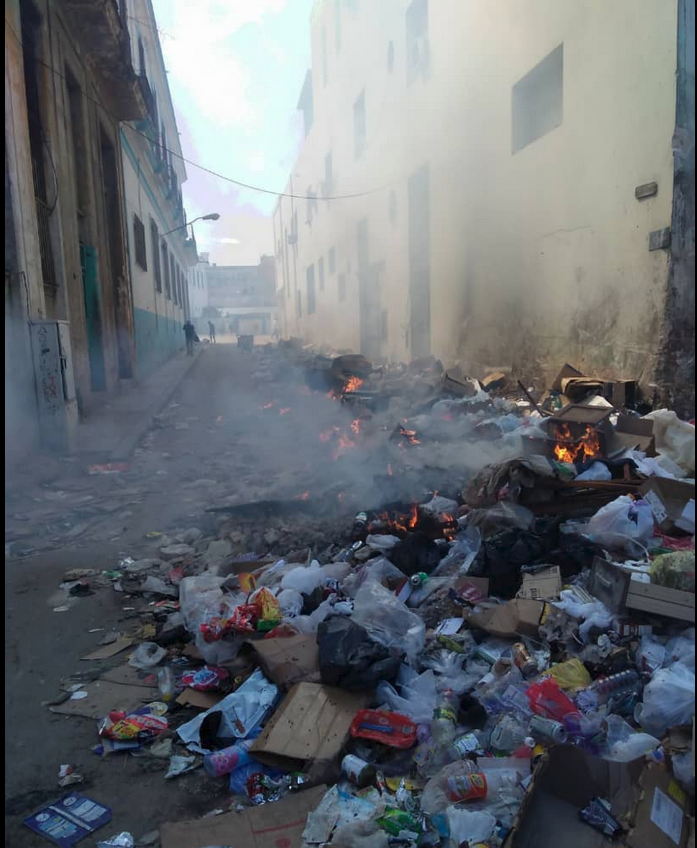
HAVANA TIMES — Garbage is burning in Havana. In recent days, social media and news outlets — both alternative and official — have filled up with photos, reports, and furious criticism of the phenomenon: hundreds of garbage dumps have caught fire.
Those dumps were already there: on nearly every corner, on every street. They grew in height and spread in size, sometimes turning into real barricades, blocking the passage of cars and pedestrians.
They were collected infrequently and poorly
Residents were not going to commit their extremely scarce savings to “self-managing” what they rightly consider the responsibility of municipal authorities. But neither the municipalities nor Servicios Comunales (the company officially in charge of the matter) took on the job: they didn’t have money for fuel for the garbage trucks, and their workers’ salaries are laughably low. The situation was left in no man’s land. A last resort, practiced for some months, was to send members of the Special Troops, the Black Wasps, of the Armed Forces to do the job of… garbage collectors.
Then, a kind of collective paranoia shot up
With the near-total fracturing of the economy following Trump’s recent measures against Cuban supplies, reports first appeared on social media about explosions and detonations in some areas of the capital. Many people attributed them to military exercises, given the “need to prepare ourselves to defend the country,” proclaimed by the government.
Barricades of smoke
The anger was total. And then, without my intending to establish a cause-and-effect link, social media began to fill with photos of burning garbage dumps, of toxic smoke reaching the upper floors of the tallest buildings, of Havana’s sky covered with thick clouds blocking out the sun, of the Malecon submerged not in sea spray but in toxic emissions that at times obscured it from view…
The same anger burned over the mysterious “who did it”: both City Services and CITMA (the Ministry in charge of the environment) disassociated themselves from any responsibility for the burning. Health officials, doctors, medical researchers, and chemists warned about the dangers of gases such as carbon monoxide, and dioxins produced by the combustion of plastics, and their threat to children, the elderly, and sick people. The photos filled posts with hashtags that became trending in just a few hours; for an entire week now, social media has been swollen with protests, denunciations, and cries for help. In recent days, fires have been reported — perhaps with no apparent causal link — but in suspicious proximity to the large dumps in historic locations of the capital.
Who was it?
That is the question that today seems to have an answer. Irresponsible neighbors, spontaneous saboteurs… the body of the crime is before our eyes and seeps into them, making people cry not only from anger and indignation but from the simple biological effect of toxic smoke.
As if a living entity, lacking individual personality, had taken over the streets, the air, and the sky of Havana.
There were those who compared the phenomenon to the “incendiary torch”: the mass burning of sugarcane fields by Cuban insurgent guerrillas during the 19th-century wars of independence.
Someone recalled the mysterious “smell of gas” that frightened the people of Havana, appearing simultaneously in several places, a few years ago.

The great fear
History knows many examples of what have — perhaps improperly — been called collective hysterias. The terror of witches, or the famous Great Fear that preceded the outbreak of the French Revolution, are phenomena that some call “mass psychoses,” well studied by specialists. When the human mass becomes impersonal, it’s as if individuals no longer exist. And in such circumstances, for a society it almost loses meaning to speak of individual responsibility. The worst cases are genocides, as in Nazi Germany or in Rwanda under “Hutu Power.”
Contained anger burned before the garbage did. The hidden violence in a society that very suddenly begins to make it visible in horrific murders and lynch-style trials, the hunger in the face of a lack of basic necessities, the uncontrollable need to express oneself in the face of what is censored and censorable, do not always move toward a “better future.”
Anger has burned over the inability to resolve an old, basic problem. But this time the fire is real. This time the damage is not “anthropological,” but simply biological.
For now, anger has set garbage ablaze across an entire megalopolis, in its centers and its peripheries. A society in putrefaction can self-combust, just as its rotting garbage can set itself on fire.
Faced with the urgent needs of a people demanding drastic changes, we do not know what comes next. We do not know who materially started the fires in Havana’s garbage dumps, but the existence of the fact itself — of the cries to prevent greater damage, in real and coinciding time and space — is a symptom of a society that has lost control over itself.
Anger and garbage are burning, and unfinished revolutions leave violent fruits.
Read more from Cuba here on Havana Times.