
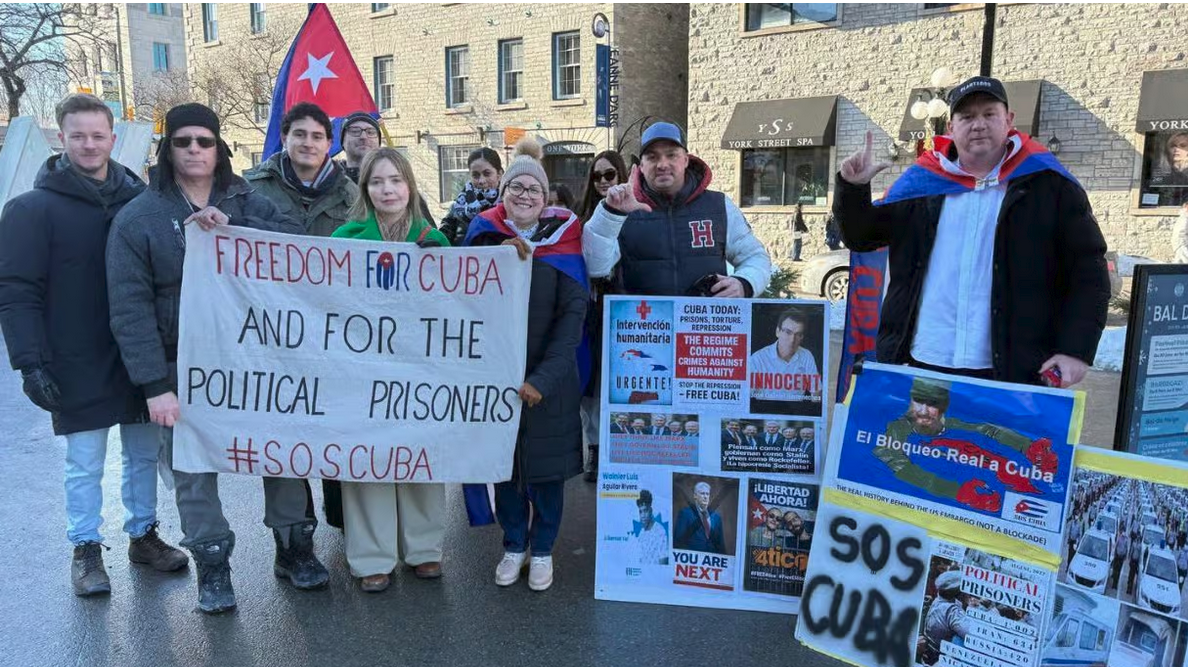
at a parliamentary hearing with Cuban activists and organizations

By Raul Medina Orama (El Toque)
HAVANA TIMES — The Standing Committee on Foreign Affairs and International Development of Canada’s House of Commons convened a special session on February 26, 2026, to address the humanitarian crisis in Cuba. Members of Cuban civil society were invited to provide testimony before the Canadian Parliament — a key country for the island due to its role in tourism, mining investment, and access to foreign currency.
The meeting took place days after the February 24 appearance of Rodrigo Malmierca Diaz, Cuba’s ambassador to Canada, before the same House of Commons foreign affairs committee. The diplomat and former Cuban Minister of Foreign Trade and Foreign Investment accused the United States government of imposing an “oil blockade” aimed at “creating a humanitarian crisis and forcing regime change” in Havana.
Raimet Martinez, president of the Cuban-Canadian Coalition (CCC), one of the organizations invited to testify, told El Toque that the CCC attended to make clear to Canadian lawmakers that “there is a serious humanitarian crisis in Cuba, but it is not the result of a recent executive order by the US administration. It is the outcome of 67 years of a system that has demonstrated its inability to govern, leading the country into economic, social, and institutional collapse”.
Martinez believes that “any humanitarian aid intended for the Cuban people must be channeled through independent civil society organizations,” some of which were recommended in a previous report sent to the Foreign Affairs and International Development Committee by the Cuban-Canadian Coalition.
“Our message to the Government of Canada is firm: if it wishes to help the Cuban people overcome this crisis, it must advocate for real political change on the island, sanction those truly responsible, demand the immediate and unconditional release of political prisoners, and promote free, multiparty elections supervised by international organizations,” Martínez, president of the CCC, explained.
Yaxys Cires, strategy director of the Cuban Observatory for Human Rights, told El Toque that he attended Parliament in Ottawa to “demand greater commitment from Canada, its government, and its institutions to changes in Cuba. The humanitarian situation in our country will not be resolved without political, economic, and social reforms.”
The House of Commons is the lower chamber and the main elected legislative body of Canada’s Parliament; it is responsible for passing federal laws, debating national issues, and overseeing the government.
Canada is historically the largest source of tourists to Cuba by country. Before the COVID-19 pandemic, more than 1 million Canadians visited the island annually, making it a critical source of foreign currency for Havana’s regime. In addition, the Canadian company Sherritt International has a strategic presence in the mining sector, particularly in nickel and cobalt extraction — key minerals for Cuba.
Although the Cuban government attributes the crisis to the US sanctions, experts have pointed out that the current energy situation and food shortages are primarily rooted in failed economic and social policies maintained for decades by the authorities.
For its part, the Government of Canada announced on Wednesday that it will send 6.7 million USD in food aid to Cuba, as the island faces an increasingly severe fuel crisis — with oil shipments slowing following US tariff threats — according to the Associated Press news agency.
Canada’s Minister of Foreign Affairs, Anita Anand, noted that she did not discuss Canada’s aid intentions with US Secretary of State Marco Rubio or with other US officials.
Meanwhile, much of Cuban civil society emphasizes that overcoming the crisis is only possible through the country’s democratization, governed without checks and balances for decades by the Communist Party of Cuba, and calls for support from the international community.
According to Raimet Martinez, of the Cuban-Canadian Coalition, “the humanitarian crisis cannot be separated from the political crisis, after decades of failed policies, lack of fundamental freedoms, repression, and imprisonment of opponents [which] have led to Cuba functioning today as a failed state.”
In addition to Martínez and other CCC members — Kirenia Carbonell (public relations director) and David Mederos, those invited to testify before the Canadian Parliament included John Suarez, executive director of the Center for a Free Cuba, and Carolina Barrero Ferrer, president and executive director of the NGO Citizenship and Freedom.
First published in Spanish by El Toque and translated and posted in English by Havana Times.
Read more from Cuba here on Havana Times.