
Using special operations forces to seize Iran’s enriched uranium, believed buried deep underground at nuclear sites bombed by the U.S. last year, would likely require a large American force on the ground, according to former defense officials.
On Saturday, President Donald Trump told reporters aboard Air Force One that he was not ruling out the possible use of U.S. ground troops in Iran, but that they would be used only “for a very good reason.”

President Donald Trump speaks to reporters while traveling aboard Air Force One en route from Dover Air Force Base, Del., to Miami, March 7, 2026.
Mark Schiefelbein/AP
He later said, “we wouldn’t do it now, maybe later,” when asked if he would use ground troops to secure the enriched uranium at Iran’s nuclear sites.
On Monday, Trump told the New York Post that he was “nowhere near” a decision on potential ground operations in Iran. “We haven’t made any decision on that. We’re nowhere near it,” Trump said.
Seizing all or a portion of Iran’s know stockpile of 970 pounds of uranium currently enriched to 60% will likely require the use of U.S. special operations forces given their elite specialized training and responsibilities said two former U.S. officials.
Iran has also enriched an additional 2,200 lbs. of uranium that has been enriched to 20%, but that the U.S. says could be enriched to weapons grade uranium in three to four weeks.

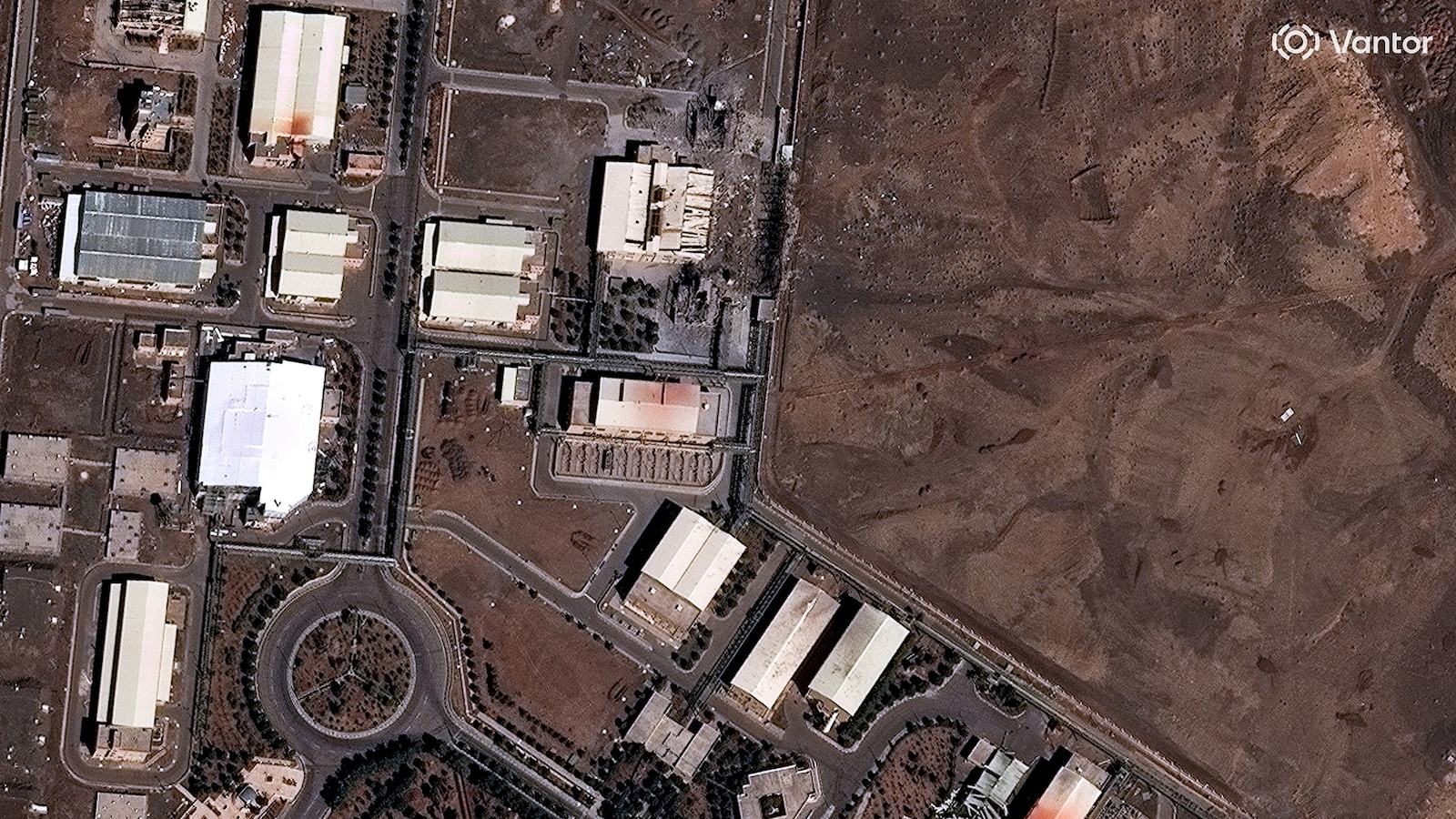
A satellite image shows a closer view of the Natanz Nuclear Facility with new building damage, amid the U.S.-Israeli conflict with Iran, near Natanz, Iran, March 2, 2026.
Vantor via Reuters
For years, Iran had enriched uranium to 60% purity for what it said were civilian use, but the U.S. countered that enrichment far exceeded what was needed for that purpose. Uranium used for civilian purposes is normally enriched to anywhere between 3 to less than 20%.
U.S. officials have noted that, after “Operation Midnight Hammer” last June in which Trump said Iran’s nuclear capability was “obliterated,” it would take Iran just one week to enrich that uranium even further to the weapons-grade level of 90% that could be used for nuclear weapons.
“They could, literally, within a short period of time, a week to 10 days on the 60%, and maybe a month on the 20%, they could have 1500 kilograms of weapons grade, which would not be 11 bombs, but be 40 or 50 bombs,” a U.S. official said.
Preventing Iran from achieving a nuclear weapon is one of the three key objectives the Trump administration wants to achieve from its military action against Iran, the other two are neutralizing Iran’s ballistic missile threat and destroying Iran’s navy.
Appearing on News Nation Monday night, former Defense Secretary Mark Esper, who served in that role during President Trump’s first term, agreed with the need for a large force and cautioned that any U.S. military mission to secure the uranium would be “very perilous, very dangerous.”
Typically, special operations raids involve a small team of operators carrying out a mission while a larger force provides perimeter ground security and air power from above to protect against a ground attack.
But securing Iranian nuclear sites and the enriched uranium that lies underneath would likely require a much larger force, according to the officials given the scope of the mission.

A satellite image shows un-buried tunnel entrances at Isfahan nuclear complex, in Isfahan, Iran, Nov. 11, 2024.
Vantor via Reuters
Going in with a larger special operations force is “a reasonable assumption,” according to the former defense official who said that each of the options are not exclusive of each other.
As with any special operations mission, the official said the mission starts out with establishing a security perimeter “so nothing can get out, and nothing can get in” all while airpower overhead ensures that the perimeter force is not overwhelmed.
Whatever the administration decides to do would determine how long those forces could stay on the ground, the former official said, asking would the administration want all the buried enriched uranium to be seized or would special operations forces destroy what remains of the facilities to make them unreachable to anyone?
Regardless of what type of mission potentially is chosen “You go in, take out what you can take out. If there’s anything left, you blow it up so nobody else can ever use it,” said the official. “Blow it up so completely,” said the former defense official. “And you can do that, so that it’s unusable.”

This handout satellite image courtesy of Vantor taken on Sept. 16, 2002, and released on March 2, 2026, shows a view of the Natanz nuclear complex facility under construction with the vehicle ramp and personnel entrances visible near Natanz, Isfahan province, Iran.
Vantor via AFP via Getty Images
Mick Mulroy, an ABC News contributor and former assistant secretary of defense for the Middle East, believes that an attempt to secure the entire uranium stockpile would require U.S. special operators to be on the ground for some time.
That might happen initially with an airborne force seizing the area to establish a protective cordon enabling a sizable assault force of elite units from Joint Special Operations Command to secure the facilities.
What might follow would be the insertion of military engineers to exploit the scene to locate the uranium, but Mulroy says better intelligence is needed.
“My question is do we even know where the material is or whether we can get to it since it might be buried,” said Mulroy.
On Monday, Rafael Grossi, Director General of the International Atomic Energy Agency, told reporters in Paris that the agency assumes that about half of Iran’s uranium enriched to 60% is believed to be stored in barrels at Iran’s Isfahan nuclear site,
“That material was in barrels, in barrels that were sealed by the IAEA. So it remains to be seen whether they are still there, but the widespread assumption is that they are still there,” said Grossi.