

By Francisco Acevedo
HAVANA TIMES – If anyone cannot afford to make a mistake in the struggle for Cuba’s freedom, it is the Cuban exile community. And this week, unfortunately, it was once again left looking ridiculous because of the failed “landing” of a boat on Cuban soil.
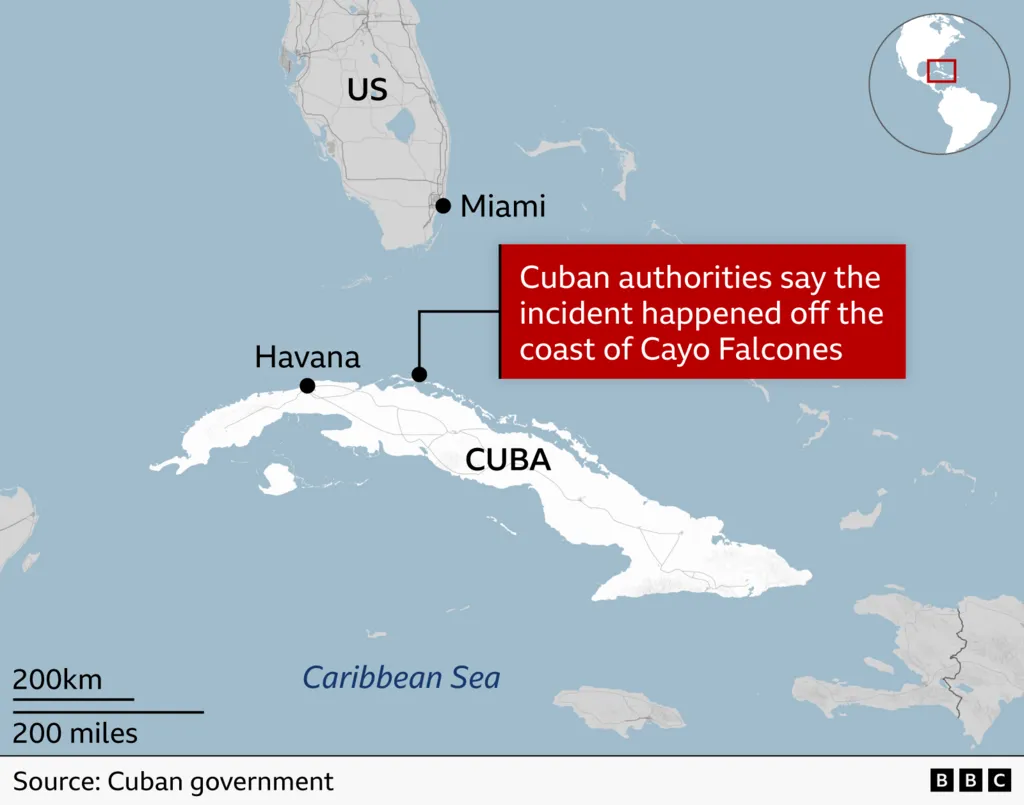
The events took place on February 25, when a vessel registered in Florida carrying 10 men exchanged gunfire that morning with Cuban border guard troops off the coast of the central province of Villa Clara.
As the information began circulating from Miami, some sources unofficially claimed it was not a terrorist landing but rather a boat heading to pick up relatives to take them to the United States. However, the cache of weapons was far too large to make that version believable.
Secretary of State Marco Rubio announced that he would respond appropriately to the Cuban government, but so far there has been no official statement from the United States. He merely said they would investigate the events independently before making any declarations.
The closest thing to a statement came from President Donald Trump, who said that the dispute between the two nations could end up “having a friendly takeover of Cuba.”
For his part, US Vice President J. D. Vance warned that his government had information about what happened before Cuba made it public — which is indeed striking.
Coincidentally, the incursion took place while Rubio was attending the summit of the Caribbean Community (Caricom), to which Cuba was not invited for the first time in its history. For some, the death of four civilians right under the official’s nose is a major affront.
There were also rumors that at the Caricom Summit itself, Rubio held strategic meetings with the grandson of dictator Raul Castro, Raul Guillermo Rodriguez Castro, alias “El Cangrejo,” who was allegedly presented with the idea of a gradual lifting of restrictions conditioned on Cuban leaders implementing deep structural changes in the nation’s political and economic system.
To speak plainly, in this context these kinds of armed “initiatives” contribute nothing to the struggle for Cuba’s freedom and instead muddy the waters, because they bring about a wave of worldwide solidarity with the poor dictators who are always attacked and only defend themselves.
At this moment, the Caribbean island is in an extremely delicate political situation, as not a few of its allies have turned their backs on it, and events like these only bring back those who were already looking at Havana indirectly.
Here, the well-known Cuban TV show host Humberto Lopez immediately seized the opportunity to stage his show with the entire cache displayed on a television set, accompanied by military and judicial personnel, to boast about how well prepared the Cuban Armed Forces are to repel any aggression and how lawful they are in respecting the rights of those arrested.
Statements from relatives of those involved suggest they were deceived by Cuban military personnel, who assured them of a friendly welcome and a notable increase in their ranks. This is hardly surprising, because for decades no one has worked better than Cuban State Security at infiltrating all exile groups, even at their highest levels.
The Cuban idiosyncrasy itself is highly susceptible to this kind of operation, because instead of the secrecy that should surround such organizations, what generally prevails is naivety and pride — now amplified using social media. They face an enemy that specializes in what it does against ordinary citizens who have no idea about the countless counterintelligence methods proven and refined over decades of work.
In a live address earlier this month, handpicked leader Miguel Díaz-Canel stated that his government was aware of preparations for incursions of this type and that information would be provided “soon.”
All of this suggests that, once again, citizens committed to the cause of Cuba’s freedom — even at the cost of their own lives — fall into traps laid from Havana to reinforce its narrative of an attacked nation and are used as banners to portray themselves as victims.
This story is just beginning, and there is much yet to be clarified, but for now the dictatorship’s narrative comes out on top.
On the other hand, Trump announced earlier this week a plan to allow fuel shipments from US energy companies directly to Cuban private businesses — something quite dangerous because it gives oxygen to the regime, since all companies authorized by the government are accountable to it; it is simply a matter of changing the front man.
Although international analysts see it as a masterstroke with a double purpose — on one hand avoiding bad press by easing the energy suffocation suffered by the civilian population, and on the other increasing Cuba’s dependence on US resources — any lifeline extended to the tyranny is extremely dangerous, at least in my view.
Throughout history, Obama included, it has been shown that every time there is a gesture of openness from the North, the island uses it to lift its head above water, without reducing repression at home by even a millimeter.
For decades we have depended almost exclusively on the United States, both formally and informally, because the chicken circulating in Cuba in this century came from there, and everything from nail polish to cars has been imported from there since the fall of the Socialist Bloc.
On the other hand, after the operation to capture Nicolás Maduro in Venezuela, it seemed that the US administration would turn all its attention toward Cuba, but now the military escalation in Iran carries more weight, and it is not possible to have so many fronts open at the same time.
The Middle East scenario is far more complex, with far greater economic returns, and it represents another long-standing obsession of Trump’s, so we will once again have to get in line and wait our turn.
Read more from Cuba here on Havana Times.