
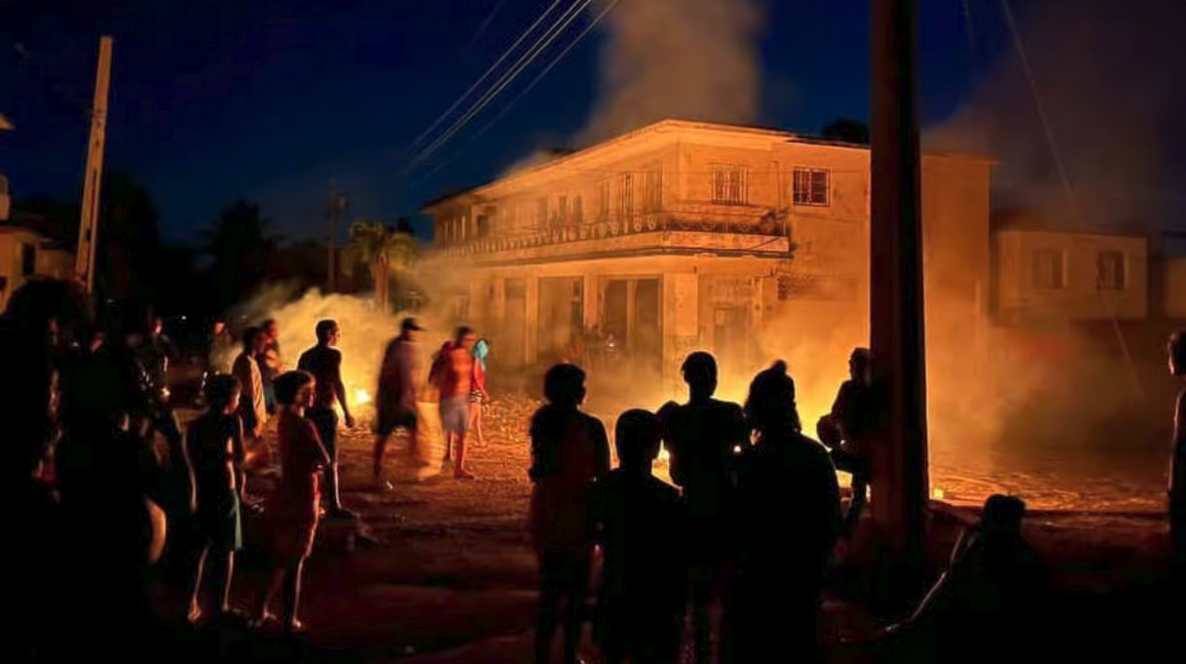

It no longer matters whether the neighborhoods are more central or less so—the soundtrack of the capital at night now sounds like protest, and the daytime smells of burning garbage.
By Dario Hernandez (14ymedio)
HAVANA TIMES — Havana at night has, these days, an apocalyptic air. A nighttime walk, when the sunlight fades and with it the fear of being recognized, has the soundtrack of pot-banging protests echoing through different neighborhoods. It no longer matters whether they are more central or more peripheral, more residential or more tourist-oriented. The noise comes from everywhere.
More and more walls also display graffiti against the Government. Even though authorities try to erase them, one phrase that sounds like a final verdict can still be seen on several walls: “It’s over.”
Fires are also dotting the geography of the capital. Some come from the burning of garbage, something increasingly common due to the shortage of vehicles and fuel that prevents even minimally adequate trash collection. Other bonfires come from the burning of charcoal, which some families use to cope with the lack of electricity and gas for cooking.
Sometimes those fires get out of control. Other times, aided by unstable electricity, a short circuit occurs. That is believed to have been the cause of a fire that broke out on Saturday at a pizzeria in downtown Santiago de Cuba, on Enramada Street between Reloj and San Agustín, which ended up setting four houses ablaze.
It is still not known why the Bucket Factory in Matanzas, located in Playa next to the Cocal substation, also burned. Although firefighters managed to extinguish the blaze in just 20 minutes on Sunday night, fear was intense because there are plastic waste materials near the affected area, neighbors warned.
Meanwhile in Granma province, El Ranchon, located at the Guisa lookout point, burned in the early hours of the previous morning. Alianna Corona Rodriguez, first secretary of the Communist Party in the province, told the press that “the flames found it easy to spread because it is a traditional construction made of palm thatch and wood.” While waiting to learn what happened, the fire has other connotations, “since posters with counterrevolutionary propaganda were found,” the official said.
In the Cuban capital, blackouts multiplied over the weekend, reaching as much as 20 continuous hours in some neighborhoods. The lack of electricity has fueled social unrest, and in some areas of Havana problems with the water supply have worsened because there is no power to pump it.
First published in Spanish by 14ymedio and translated and posted in English by Havana Times.
Read more from Cuba here on Havana Times.