
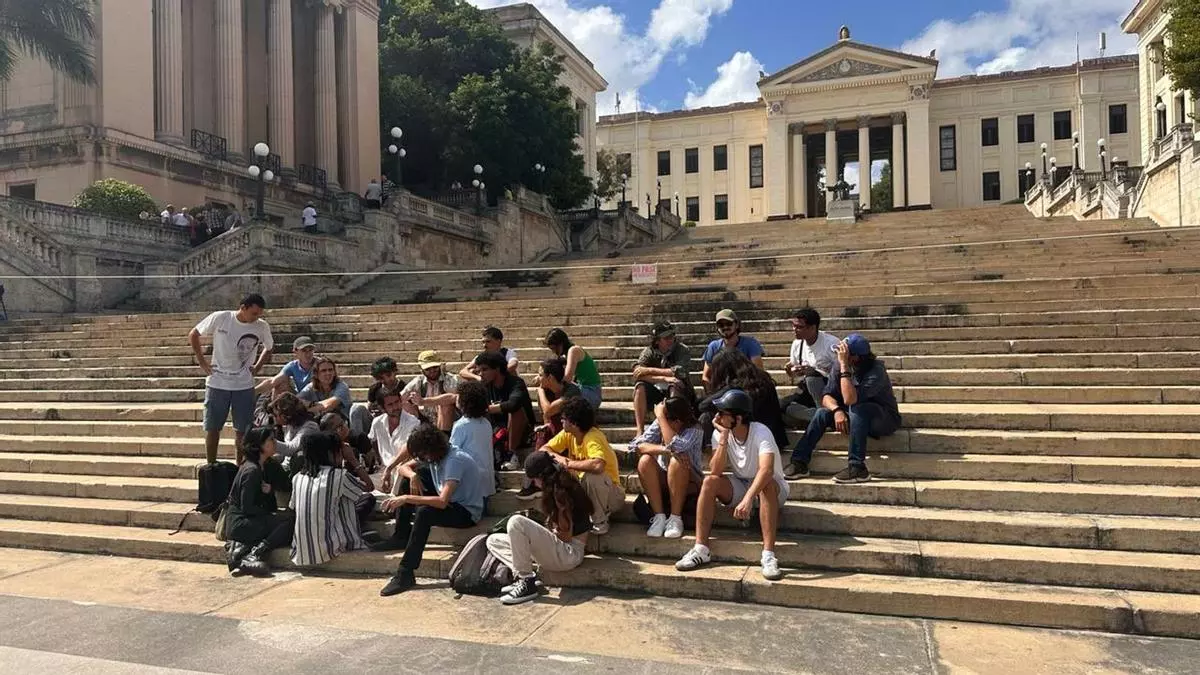
on the steps of the University of Havana

The Federation of University Students tried to prevent the protest called to express “the students’ dissatisfaction with the current teaching plan”
By Darío Hernandez/Juan Diego Rodriguez (14ymedio)
HAVANA TIMES – About twenty students are meeting with education authorities after holding a peaceful protest on the steps of the University of Havana this Monday morning. Around 3:00 p.m. on Monday, the site showed no trace of what had happened several hours earlier, except for the internet connection still being blocked
The students, around 25 in number, occupied the stairs in a peaceful protest. As stated on the poster circulated through a WhatsApp group, the “university sit-in” was scheduled for March 9th at 10 am “to publicly and peacefully demonstrate the student body’s dissatisfaction with the current teaching plan.”
The situation, an eyewitness reported to the organization Ciudadanía y Libertad, (Citizenship and Freedom), “remained calm at first,” but “changed when more students began arriving, interested in joining the protest.” Then, the sources continued, State Security agents blocked more people from entering the steps and the university grounds.

According to CNN correspondent Patrick Oppmann in Havana, who posted a picture of the protest on his social media, the students who had previously been on the steps entered the center to meet with officials and authorities.
The rector of the University of Havana, Miriam Nicado Garcia, and the first deputy minister of Higher Education, Modesto Ricardo Gomez, approached the place where the young people were gathered.
“How many hours of electricity did you have last week? And do you have a connection when the power is cut off?” a student asked a dean, according to EFE.
“Many students from the provinces haven’t been able to submit anything because there’s no connectivity,” another student said.
These mainly academic demands were gradually overtaken in the conversation by complaints about how university students can raise their issues and participate in the debate on solutions and decision-making processes.
“The paths to reach the Ministry of Higher Education are obstructed,” a young woman stated, to which a student added: “This sit-in, I’m afraid, is a last resort.”
The Vice Minister of Higher Education directly addressed the young people in an attempt to end the sit-in: “This isn’t going to solve the problems we have.” He said he knew that, “because my whole life has been dedicated to educating you?”

“You haven’t listened to us from the very beginning: that’s the answer you have,” a young man retorted.
In fact, the students had started to feel sidelined last week and, faced with what they perceived as decisions made from above, they created several alternative discussion groups on social media and launched the call for the sit-in.
Both the University of Havana administration and the FEU quickly came out to say that this initiative was “fake” and stressed that the established dialogue spaces were working.
Several students highlighted that part of the erosion of trust in the University and in the FEU began last June, when the students’ discontent over a very sharp increase in the rates for mobile phone service by the state-owned telephone company was not addressed as they wished.
On the other hand, in the early afternoon, in the WhatsApp group for the call to protest, the students posted: “For all those who are following the situation, the group that responded to the call is in dialogue with the Minister of Higher Education, expect more information before the end of the day.”
In a letter shared on their social media, the organizers addressed the Secretariat of the University Student Federation (FEU), responding to a statement in which the pro-government organization dismissed the call, calling it “completely false” and “unnecessary”.
“We feel an obligation to respectfully disagree with your posture,” the missive stated. “Defending institutional dialogue is correct but claiming that it exhausts all legitimate forms of expression is a mistake.” In four points, the students explained why the sit-in “is both real and necessary.”
First, they said, because “it is not a denial of dialogue, but rather its deepening.” A sit-in, they explained, is a tool to demand dialogue “when it becomes insufficient or slow” and “means bringing concerns to the forefront,” so that the “actions” taken by educational authorities “do not remain in closed spaces but rather become the focus of collective dialogue.”
On the other hand, they alluded to the fact that the FEU Secretariat told them they had already been “receiving concerns.” “This is valuable, but it’s not sufficient,” they retorted. “The legitimate question many have is: what happens to these concerns once we communicate them to you?” The protest, they argued, “seeks to break down the intermediaries and create a horizontal space, student to student, to compare opinions and reach our own conclusions, unfiltered by a structure.” And they continued: “If the current channels were effective, there wouldn’t be this spontaneous need for hundreds of students to seek an alternative way to organize.”
On a third point, they criticized the FEU for referring to their action as “symbolic,” “as if it were something negative.” They argued: “The history of the University of Havana is built on symbols. Sitting in a common place, looking each other in the eye, and debating the problems of teaching and the situation of the country is a profoundly transformative act.”
Finally, they referred to the “management of solutions” that the Secretariat had offered them. “We appreciate their work, but the solution to the problems in teaching and the general discontent cannot simply be to ‘wait’ for them to be managed. The university community must be an active part in creating those solutions.”
The worsening energy crisis has led to the suspension of in-person classes at all universities, a cancellation that has left thousands of students at home. Maintaining contact with teachers through WhatsApp groups and other virtual platforms is not a viable option in a country where internet access is becoming increasingly unreliable.
Translated by Translating Cuba.
Read more from Cuba here on Havana Times.