
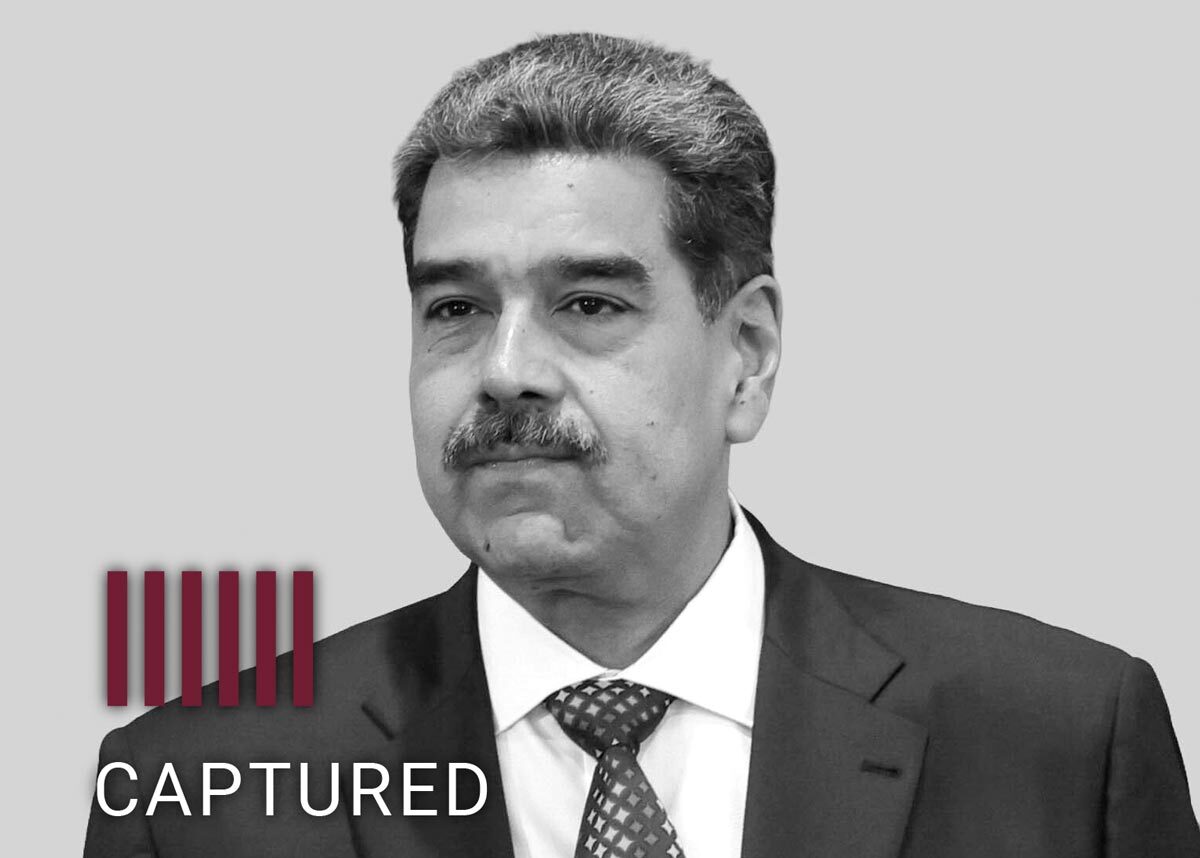
The former president of Venezuela, Nicolás Maduro, oversaw the consolidation of a hybrid state in which governance and criminality became deeply entwined, transforming the country into a regional hub for organized crime. After taking office following Hugo Chávez’s death, Maduro expanded relationships with armed groups and illicit networks to repress political opposition and secure streams of illicit revenue, embedding corruption within the state apparatus.
On January 3, 2026, Maduro was arrested in Caracas in a military operation by the United States and flown to New York to face federal drug and weapons charges.
What Is Nicolás Maduro’s Criminal History?
Nicolás Maduro was born into a left-wing family in Caracas in 1962; his father was a labor union leader. From a young age, Maduro was involved in leftist political parties, first as a member of the Liga Socialista and later in various organizations that backed Hugo Chávez’s rise to power. His work in these circles took him to Cuba for a period of study, where he deepened his ideological commitments.
By the late 1980s, he was working as a bus driver in Caracas. He rose quickly to become a union leader, and climbed the ranks of the political movement that, in 1998, helped Chávez win the presidential election.
In 1999, Maduro was elected to the Constituent National Assembly that drafted Venezuela’s new constitution. In 2000, he became a representative in the National Assembly, and in 2005 became president of that body, where he was a key legislative operator for Chávez.
Maduro then left the National Assembly to become foreign minister in 2006, a position he held for seven years until he was appointed vice president by Chávez in 2012.
During the 2000s, with Maduro as a key figure in his government, Chávez began laying the foundations of the hybrid state. He opened the government’s doors to Colombian guerrilla groups like the Revolutionary Armed Forces of Colombia (Fuerzas Armadas Revolucionarias de Colombia – FARC) and the National Liberation Army (Ejército de Liberación Nacional – ELN). Chávez tolerated official corruption and presided over the growth of armed pro-government groups known as colectivos, granting them resources, arms, and informal authority in exchange for loyalty.
When Maduro assumed the presidency in 2013, he inherited this hybrid system and used it to help him cling to power despite prolonged economic collapse and social unrest.
Global oil prices plummeted starting in 2014 as new US production flooded the market, drastically reducing revenues from Venezuela’s most important economic sector.
Rising inflation, food scarcity, and insecurity produced mass protests that were met with repression. Maduro responded by solidifying relations with armed groups, like the colectivos, which helped the armed forces to quell protests. Maduro also oversaw deepening relations between his government and Colombian guerrilla groups, which provided access to illicit revenue streams in addition to political support and a deterrent against a military incursion from neighboring Colombia.
To keep rising prison violence under control, his government handed over administrative functions to gangs operating inside prisons, known as pranatos. These groups were allowed to operate freely, both inside and outside prison walls, in exchange for bringing down the violence behind bars.
To address insecurity on the streets, Maduro’s administration launched a plan to disarm criminal gangs. The policy barred security forces from entering gang-controlled areas, which became known as “peace zones.” Rather than disarming, however, criminal groups grew stronger, ultimately becoming parallel authorities in those areas.
With the creation of the Orinoco Mining Arc in 2016 — a region rich in gold, diamonds, and other minerals — Maduro formalized a new stream of criminal revenue to finance the country and enrich corrupt officials. The area, which had been irregularly exploited for years, was already home to illegal mining groups known as sindicatos, which maintained alliances with elements of the state.
In the latter half of the 2010s, the situation worsened as corruption and poor economic management piled up. Repression and criminality within the regime increased, and the United States took an increasingly aggressive posture toward Maduro and his regime.
The United States started sanctioning government officials in 2015. Then it targeted Venezuela’s oil industry in 2017, followed by another set of sanctions against the gold industry in 2019. The economic implosion that had spurred mass emigration, coupled with the COVID-19 pandemic that began in 2020, exacerbated the long-running crisis. Maduro also lost democratic legitimacy due to allegations of fraud in the 2018 elections that kept him in power.
In 2020, the United States issued criminal charges against Maduro and several senior Venezuelan officials, accusing them of supporting terrorism and trafficking drugs. Maduro was charged with heading the so-called Cartel of the Suns, a catchall term for widespread corruption in the Venezuelan military that was portrayed inaccurately as a hierarchical criminal group.
In the following years, Maduro’s government was forced to regulate the broad criminal landscape it had allowed to flourish for years. It pursued multiple gangs that challenged its authority, revoked the pranato’s permission to control the prisons, and dismantled criminal and drug‑trafficking networks that failed to comply with its directives.
In 2024, Maduro once again declared victory in elections marred by fraud. With a de facto presidency, Maduro’s government increased repression and deepened its reliance on allied organized crime groups.
US pressure on Maduro ramped up significantly in 2025 after US President Donald Trump took office for his second term. The Trump government labeled the Cartel of the Suns a terrorist group and raised the bounty on Maduro to $50 million. The United States also began a campaign of lethal military strikes on suspected drug boats leaving Venezuelan shores, starting in September 2025.
The pressure campaign culminated in a US military operation in the early hours of January 3, 2026, which arrested Maduro and his wife, Cilia Flores, and brought them to be prosecuted in the United States.
What Crimes Has Nicolás Maduro Been Involved In?
Nicolás Maduro permitted and participated in a broad range of criminal activities intended to maintain his grip on power.
Drug trafficking was a key criminal economy. Maduro allowed officials and security forces to take bribes from traffickers and to directly facilitate illicit shipments, providing them with income to supplement their unlivable government salaries.
One prominent example of the protection Maduro offered to drug traffickers is the case of Venezuela’s former anti-narcotics chief Nestor Reverol. When the United States charged Reverol with drug crimes in 2016, Maduro responded by promoting Reverol to interior minister the very next day.
Illegal mining also provided significant revenues for the regime. Maduro’s government partnered with gangs known as sindicatos, helping them control and exploit gold deposits in exchange for a cut of the profits as well as their backing for Venezuela’s disputed claim to a region of Guyana called Essequibo.
Maduro’s administration devolved control of the prison system to pranes (prison bosses), who were allowed to govern prison life and run external criminal branches of those organizations in exchange for keeping the peace and sharing profits with the state.
Under Maduro, state coffers were pillaged on an industrial scale via embezzlement, currency manipulation, and the control of government contracts, such as the provision of subsidized food, according to investigations by InSight Crime.
Other journalistic investigations linked Maduro and members of his government to money laundering and sanctions evasion schemes.
Where Did Nicolás Maduro Operate?
Under Nicolás Maduro’s orders, the Venezuelan government allowed organized crime groups and criminal networks to operate with virtual impunity in key areas of the country.
Strategic zones in Venezuela’s coastal states became departure points for drug shipments bound for the Caribbean and international markets, trafficked by drug networks with ties to state actors.
Likewise, the porous border with Colombia became, with Maduro’s blessing, a refuge and operating area for guerrilla forces, especially the ELN. In the state of Zulia, which borders Colombia’s strategic coca‑producing Catatumbo region, the Colombian‑Venezuelan guerrilla controls drug‑trafficking routes. In Táchira, adjacent to Colombia’s Norte de Santander department, the ELN has maintained control over cross‑border illicit revenue streams with the help of local authorities — as it has in Apure, another key drug‑trafficking zone.
In the south, the state of Amazonas is home to protected natural parks that are illegally exploited by multiple actors, including security forces tasked with protecting the territory. Bordering Colombia’s Vichada and Guainía departments to the west, ELN guerrillas and former FARC guerrillas who abandoned a 2016 peace agreement with the Colombian government have a presence there. Along the southern border with Brazil, illegal Brazilian miners known as garimpeiros operate. The triple frontier between Colombia, Brazil, and Venezuela is a busy transit point for drugs, gold, rare minerals, and other contraband.
Urban areas in some of Venezuela’s major cities — such as the capital, Caracas, and Maracay in Aragua — have been ceded to criminal groups at times that, in alliance with corrupt government and security officials, have established themselves as parallel authorities, maintaining social control in favor of the regime and coercing citizens to vote for pro‑government candidates, including Maduro.
The Orinoco Mining Arc created by Maduro in Bolívar operates under a hybrid criminal system in which state officials ally with criminal groups. The gold extracted there ends up in the hands of government officials, but it does not reach the nation’s coffers; instead, it is smuggled out in shadowy deals that enrich regime-connected figures.
Adjacent to Bolívar is the Essequibo region, a vast, sparsely populated territory rich in minerals that Venezuela and Guyana have disputed for years. In 2023, Maduro revived the dispute over the Essequibo with little success. Since then, however, Guyanese armed forces guarding the region have been attacked multiple times by armed men from the Venezuelan side. InSight Crime investigations found that sindicatos from Bolívar expanded their mining operations into Essequibo in the early 2020s.
Who Were Nicolás Maduro’s Allies and Enemies?
The hybrid criminal system that Nicolás Maduro established allowed elements of the Venezuelan state to form alliances with a wide array of criminal actors and networks.
Key connections within this system have occurred in the security forces. Longtime Defense Minister Vladimir Padrino López was a crucial ally of Maduro in controlling the armed forces and embedding criminal influence within them. Another military man, Interior Minister Diosdado Cabello, had occasional rivalries with Maduro but was instrumental in controlling security forces and in managing and regulating criminal revenue streams, especially drug trafficking.
Delcy Rodríguez, who served as Maduro’s vice president starting in 2018, was a key political and economic operative for years, enabling evasion of international financial sanctions and aiding the plunder of the state oil company PDVSA.
Politicians who challenged Maduro’s interests or exceeded their bounds — such as former oil minister and vice president Tareck El Aissami — were sidelined or had their corruption turned against them in selective prosecutions.
Maduro also developed close ties with financial operators like businessman Álex Saab, who was implicated in shady petroleum and mining deals as well as sanctions evasion and money laundering. Saab has faced US money‑laundering charges and was extradited from Cape Verde to the United States before being returned to Venezuela in a 2023 prisoner swap.
On the criminal side of the system, Maduro maintained deep alliances with Colombia’s ELN guerrillas and dissident factions of the FARC. These groups have been accused of colluding with senior levels of his government and parts of the armed forces, reportedly receiving logistical support and weapons.
Maduro’s arrival tipped the balance of power away from the FARC dissidents in favor of the ELN. This allowed the guerrilla group to expand across the Colombian-Venezuelan border, where they collaborate with state security forces.
This relationship grew to be critically important for the regime because the ELN’s discipline and military capabilities cemented its potential as a paramilitary force, which could help the regime control strategic territories and populations, regulate certain criminal economies, and combat unwanted criminal groups.
Following the 2016 demobilization of the FARC, dissident factions continued to operate from former strongholds inside Venezuela. One faction, known as the Second Marquetalia, maintained ties to the Maduro government, whose leaders publicly welcomed them after they abandoned the Colombian peace process. However, in the years that followed, the group’s influence waned after the deaths of some of its leaders.
In Apure, the Maduro government labeled another FARC dissident faction, the 10th Front, as terrorists in 2020 and launched direct attacks on its main base of operations.
The United States has alleged Maduro’s government worked with prominent drug trafficking groups, including the FARC, the ELN, and Mexican drug trafficking organizations the Sinaloa Cartel and the now-defunct Zetas.
Initially, Tren de Aragua was granted its own criminal headquarters by the Maduro regime in the Tocorón prison, in the state of Aragua, where the group was born. But the gang began to spread into other countries around the region, generating international pressure on Maduro to crack down. Maduro turned against the gang in 2023, and declared it wiped out. Though some elements of the group maintain ties to the state, the breakdown of the alliance weakened the gang.
Similarly, Maduro eventually lost control over the country’s other “megabandas,” many of which were initially granted their fiefdoms by his government in peace zones. Maduro’s drive to reassert authority led him to go after those gang leaders and dismantle their power across the country. Only the Tren de Llano gang remains, though it has been extremely weakened.
What Is the Outlook for Nicolás Maduro?
Nicolás Maduro remains in US custody awaiting trial following his arrest. His career as a criminal player is effectively over, as he is likely to spend much of the rest of his life behind bars in the United States.