

By Fabiana del Valle
HAVANA TIMES – My life has turned into one of those memes that aren’t funny, the kind that hurt because they portray a reality that is as absurd as it is true. The blackouts multiply like one of those biblical plagues that struck Egypt. Fuel disappears, and of course public transportation—which was already scarce—“shines by its absence.” Yet here we remain, counting every step that takes us further from development while time rewinds to the age of the aborigines.
On social media there’s no shortage of jokes showing Cuba’s involution. Back to the caves or into huts made of mud and straw, sitting beside a fire lit with two stones. I don’t laugh anymore; it’s been a long time since the metaphor stopped being an exaggeration.
One of these days it will be more feasible to buy a bicycle than a Hyundai Santa Fe. I know it sounds like a joke, but even for the “entrepreneurs” who, one way or another, have managed to fulfill the dream of owning a little car, it’s hard to pay 6,000 pesos for a liter of gasoline—about 12 USD.
A bicycle will become a symbol of status, survival, and privilege. On this island, resistance is mandatory: if you have the means, you move forward; if not, you walk—and if you can’t walk, may God help you.
Many worry about rising prices, and those who can hoard products for when “things” reach “zero.” The problem is clearly defining point zero. More blackouts, scarcity, and resignation? For me, we hit rock bottom a long time ago, it’s just that our bottom has basements.
In truth, what worries me right now is not the price of oil, rice, or a bicycle. In these subjects, Cubans always earn top marks. There are many years of practice, and survival is the priority. I’m not even going to mention public health, which is already nonexistent. What truly frightens me is education—the future of our children, which grows more distant every day.
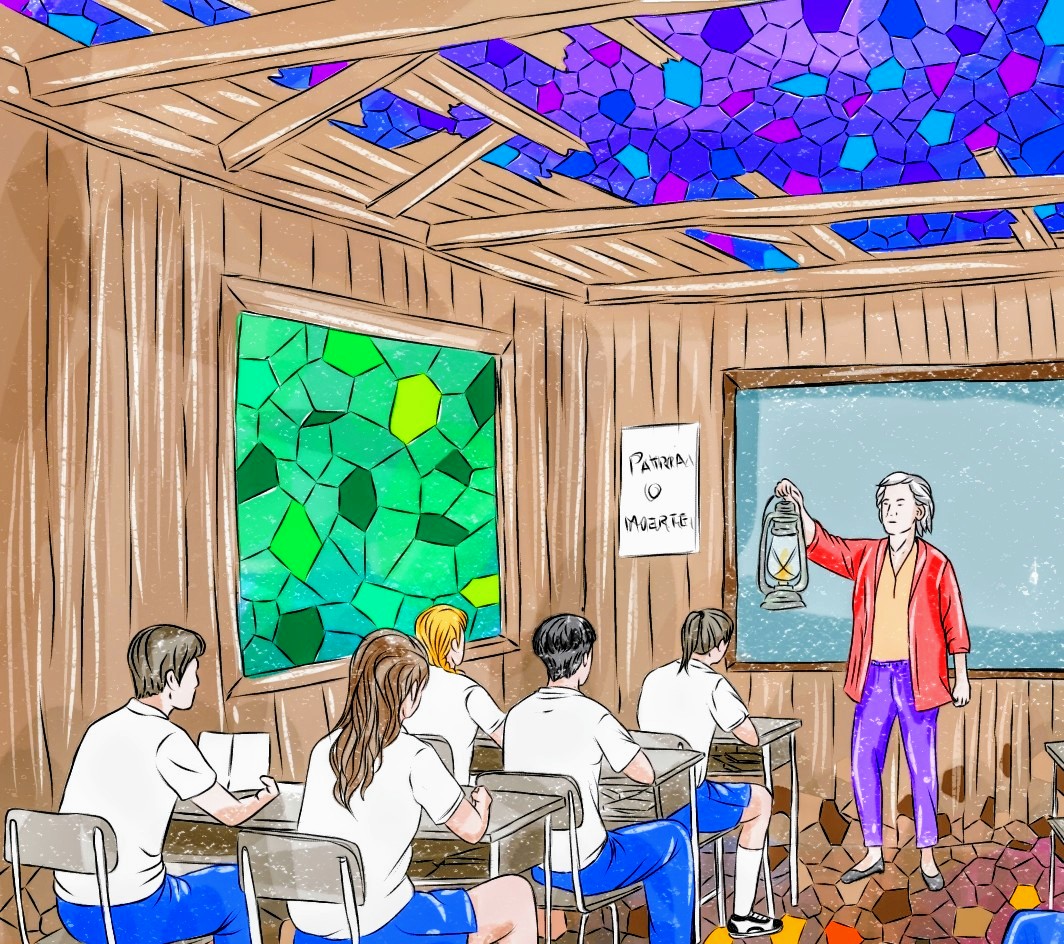
Because of the “current situation the country is going through,” students from boarding schools were sent back to their home localities. It was assumed that pre-university students would attend nearby centers. This sounded moderately logical in the absurd minds of our leaders. Reality, as always, is different: without transportation, these children can’t even travel five kilometers.
Then came the “brilliant solutions”: let them attend the nearest school in their area, no matter if it’s an elementary or middle school. At this point you cry and laugh at the same time; faced with irrational measures like this, if you don’t treat it as a joke, you break.
My daughter should focus on chemical formulas, cells, and equations, but instead she must attend her small rural school. There, due to the shortage of educators, a single teacher gives classes to third, fourth, fifth, and sixth grades all at once. There is no more absurd image than a group of pre-university teenagers sitting in those small, rickety desks, waiting for a specialized teacher to magically appear and teach the subjects they are supposed to receive.
Another issue is that the measure is not applied equally. Children in cities and towns have the privilege of attending their educational centers, where they continue receiving classes and being evaluated. Are we returning to countryside regions full of illiterate people? Isn’t education a right for everyone?
How do I build a future for my daughter if it’s being dismantled piece by piece? I’m not talking about luxuries—I mean basic opportunities, real knowledge, the tools that will allow her to defend herself in a world that does not forgive improvisation.
Those in power move the pieces on their corrupt chessboard; they decide, readjust, and announce “provisional” measures. I can’t remember a single provisional measure that didn’t end up staying with us permanently. The light at the end of the tunnel has gone out; over time, the tunnel itself has grown far too long.
The true involution isn’t returning to the caves—it’s getting used to this, accepting that our children live without guarantees, repeating “this is temporary” like a mantra while time passes and their youth, energy, and hope of becoming professionals slip away.
There are many things I don’t understand, and the answers escape me. I only know that I don’t want my daughter to survive blackouts as if they were seasons of the year. I want her to truly learn science, to be able to choose whether to leave or stay, to have a future that doesn’t depend on a liter of fuel or a bicycle turned into a national treasure, to not have tears well up at the sight of such an uncertain future.
Perhaps there is no light at the end of the tunnel, but for her I will remain firm in the absolute conviction that we were not born to live inside it forever.
Read more from the diary of Fabiana del Valle here.