
An interview with author Martha Bátiz

By Selena Mercuri*
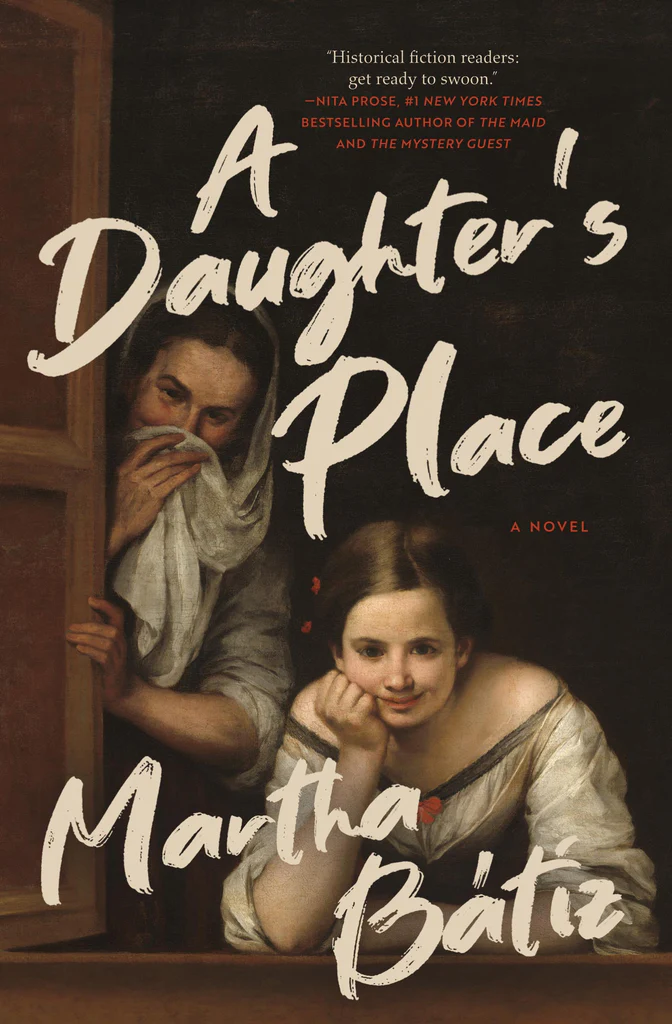
HAVANA TIMES – When Martha Bátiz stumbled upon Isabel de Saavedra’s story while researching Early Modern Spanish theatre for her doctoral dissertation at the University of Toronto, she knew immediately that this was something extraordinary. Isabel—the illegitimate daughter of Miguel de Cervantes, author of Don Quixote—had been largely erased from history, vilified by literary critics as an ingrate and a bitter woman. But Bátiz saw something else: a young woman forced to pose as a maid to preserve her father’s honour, denied his surname, and supporting his literary genius from the shadows alongside four other remarkable women.
What followed was a sixteen-year journey to bring Isabel’s story to light. The result is A Daughter’s Place (House of Anansi, 2025), a sweeping historical novel that reclaims the lives of five women who shaped Cervantes and his masterwork. Through distinct narrative voices—Isabel’s first-person accounts, Catalina’s prayers, Magdalena’s letters, and Constanza’s third-person chapters—Bátiz breathes life into women who history tried to forget.
Now, this April, the book comes home. Las Cervantas, Bátiz’s self-translation into Spanish, will be published by Hachette Livre in Mexico, with a launch event on April 26 in Mexico City.
Bátiz is no stranger to navigating between languages and cultures. An ATA-certified literary translator, she has supervised translations of other Hispanic-Canadian authors and created the anthology Desde el norte: narrativa canadiense contemporánea. Her award-winning novella Boca de lobo was originally published in Spanish both in the Dominican Republic and in Mexico, and released in its first English translation as The Wolf’s Mouth. She is the author of two Spanish-language short story collections (A todos los voy a matar and De tránsito) and two English-language collections (Plaza Requiem: Stories at the Edge of Ordinary Lives and No Stars in the Sky), and has been recognized as one of the Top Ten Most Influential Hispanic-Canadians.
You mentioned discovering Isabel’s story while researching Early Modern Spanish theatre for your doctoral dissertation at the University of Toronto. What was the initial moment of discovery like, and when did you realize this had to become a novel?
Thank you, Selena! The moment of discovery was at the end of a class on Cervantes’ literature at the University of Toronto. I don’t remember exactly if it was my professor or one of my classmates who told me that Cervantes had an illegitimate daughter, and I was immediately intrigued. The desire to find out more information stayed with me for a while until I finally decided to look into the matter a few months later, and little by little, in my spare time, I began searching for documents, papers, any information I could find that talked about this daughter of his. I knew this had to become a novel once I saw how the women in Cervantes’ family made it possible for him to become the writer that he was, at a great sacrifice to themselves. Wow, I thought, here’s this man, certainly an incredibly gifted writer, poet, and playwright, whom we all revere, but he had this career thanks to the support he received from his family –his sisters, niece, and wife. And no one has heard about them. I knew right away this had to be fixed.

You described Isabel’s life as having telenovela qualities. How did growing up in Mexico City watching (and acting in!) telenovelas influence your approach to this historical narrative?
This is a lovely question. Telenovelas have influenced my life in many ways, not only because I grew up watching them, but because I had a blast acting in them. Isabel didn’t know Miguel de Cervantes was her father until her mother died and he, unlike so many other men (at the time, and even now), stepped up to take care of her. Imagine being 15 and finding out that you have been lied to all your life, and then being forced to move in with, basically, strangers, because they are your “family.” To make matters worse, you need to dress like the maid so as not to embarrass them with your presence, because you are illegitimate and, therefore, must remain hidden even if in plain view. It’s so dramatic! And yet, it’s something that I saw in telenovelas over and over. That line that says, “Your real father is…” (dramatic music), I simply had to do that, for kicks and also because this is how I imagine that it was. After all, telenovelas do come from real life, even if they exaggerate or over dramatize events. I just didn’t know how much Cervantes’ life was like a mix between an action movie and a telenovela. It was thrilling to discover that, or to make that connection.
The novel uses different narrative forms—Isabel’s first-person chapters, Catalina’s prayers, Magdalena’s letters, and Constanza’s third-person sections. How did you decide on these distinct voices?
It was a process. I started the novel many times, rewrote the early chapters endlessly until I found the right voice and tone for Isabel, and then did the same thing for Constanza. Once those two voices were established, the others came to me in a quite natural way. Since Cervantes travelled so much, it is logical to think that he sent letters to his sister, and that she wrote back to him. And since his wife was very religious, imagining her sharing her tribulations through prayer was also a logical choice.
Can you elaborate on the connection between the female characters Cervantes created and the real women who surrounded him?
I believe that Cervantes was a proto feminist. His female characters are built with huge empathy, and I used my favourite one in the novel as proof (Marcela, the shepherdess, who flees the city to live in the mountains, alone). Women back then had no freedom at all, and clearly, they yearned for it. Cervantes gave some of his most emblematic female characters both agency and freedom. His sisters were very independent; they lived on their own. While he was the male figure of the family, he was often absent for months at a time (years, even, when he was in exile). So, these women didn’t need a man with them to survive, they lived life their own way. And people criticized them. There were ugly rumours about their behaviour and morals. My hypothesis is that through his characters, Cervantes wanted to show that women were judged and treated unfairly (as is Marcela in that wonderful scene of Don Quixote, but she defends herself so well!). He must have seen how hard society was with his sisters and wanted to address that in his work. Having said this, he was still a man of his time, so that doesn’t mean he was going to let his daughter, illegitimate or not, live life the way she saw fit. And that’s why theirs was a difficult relationship. Isabel was very independent, very smart, a woman ahead of her time. And her father, although understanding, still wanted to control her choices. It was his right. This is why all hell broke loose in that family. It’s fascinating and heart-breaking at the same time.
You’re known primarily as a short story writer, with two award-winning collections. How did the transition to novel-writing challenge you differently? What did you learn about sustaining narrative across 17 years of Isabel’s life?
Writing this novel has been the single, hardest thing I have done. Short stories can be written in a single sitting. Then, of course, there’s the editing process, but you can move quite easily from one story to the next and take long breaks in between (which I did, because my teaching load is so heavy that I don’t have time to write as much as I’d like). With a novel you cannot do that. Novels are jealous, and possessive. They want all of you there, with them, all the time. For me, balancing that was a huge challenge, because my life is so busy and full of distractions (which is a euphemism for everything having to do with work, house chores, parenting, you name it). From this process I learned patience, dedication, and long-term focus. Veeeeery long-term focus.
During an interview at the Toronto International Festival of Authors, you mentioned that you were translating the book into Spanish yourself. What has that process been like? Did you find yourself making substantial changes to the Spanish version, or were you trying to stay faithful to the English original?
I love this question. The English version was my blueprint, but in Spanish I feel much freer. I made a few subtle but, in my opinion, necessary changes. Spanish is my mother language, so my vocabulary is richer (and there’s no need for me to run to dictionaries every ten seconds to check how something is said or make sure I’m not mistaken). Translation worked as revision for me. A chance to make my work better. It’s a privilege, really, because I’m very happy with the English version of the book, but in Spanish it does have a different flavor. My challenge was that Cervantes cannot speak like a Mexican and, while I am familiar with the Spanish from Spain (which is slightly different from mine), I was afraid of creating characters that didn’t sound true to their environment. I was lucky to have friends who helped me ensure I got those Spanish-from-Spain expressions and nuances right. I will forever be grateful to them. The acknowledgements section in Spanish is definitely longer than the English one.
A Daughter’s Place has been called “the kind of novel that begs to be taught and discussed.” What conversations do you hope it sparks, particularly among readers who may be encountering these women’s stories for the first time?
Again, wonderful question. I hope it sparks interest in the way women lived, in what they had to endure. We are so lucky to live in this day and time, and in this part of the world, that we take a lot for granted. And the moment you take something for granted, in my experience, you are at the most risk of losing it. You cannot let your guard down. I hope my work highlights the importance of feminism (even if the term is anachronistic when mixed with a 17th century plot). And I hope that people who read this book and are encountering these women’s stories for the first time will think long and hard about how many other men have become immortal thanks to the sacrifice of women who have stayed in the shadows. We must give women more credit for their efforts and selflessness —their devotion, really, in the past, in the present, and in the future. We need to value women’s work and recognize it. Acknowledge them. This novel is my tribute to Isabel, Constanza, Andrea, Magdalena and Catalina. We must name them. Remember them. Without them, there would be no Don Quixote, and Western literature would be very different. The debt we have to them is immense. It’s important to be aware of how much we owe to women like these. I wanted to raise this awareness, hoping that it would, in turn, lift other women from the shadows.
*Selena Mercuri is a writer and publishing professional based in Toronto. Her work has appeared in The Literary Review of Canada, The Fiddlehead, Room Magazine, and other publications. You can follow her on Instagram at @selenamercuriwriter and find out more at www.selenamercuri.com.
Read more Book Reviews & Interviews here on Havana Times.