
“I Still Hurts a Lot”

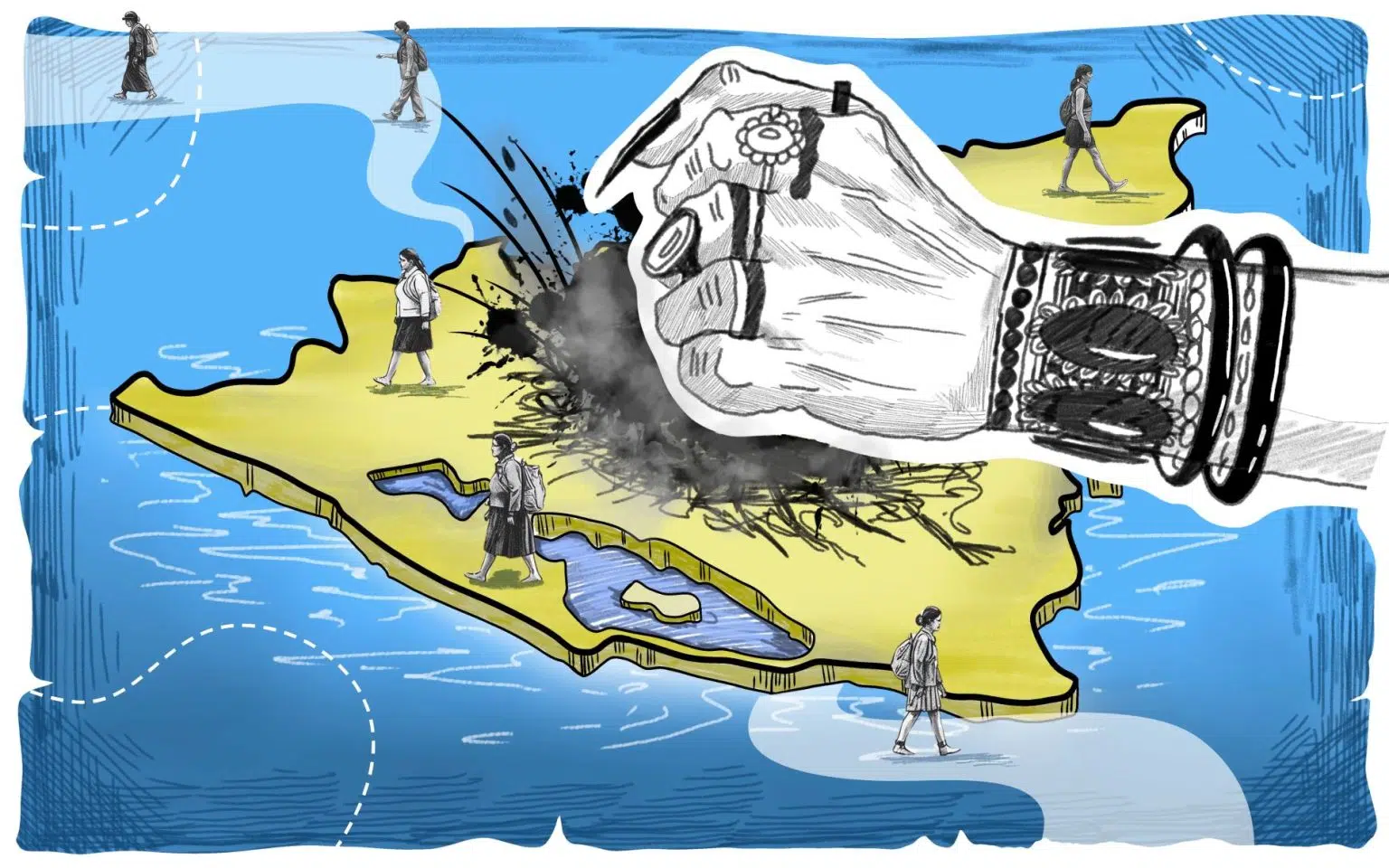
Persecution, imprisonment, and forced displacement reveal how the dictatorship stripped hundreds of women of the right to live in Nicaragua.
By La Lupa (Confidencial)
HAVANA TIMES — Speaking is not easy. For Mayela Campos, a former political prisoner who was forcibly banished from her country, it is painful. Even so, she does it, because for her, naming what she lived through is also a form of denunciation—so that it is not forgotten.
Her story is not the only one in the country. Since 2018, hundreds of women who dissented from the dictatorship of Daniel Ortega and Rosario Murillo have been victims of political violence that does not manifest in a single way nor affect them equally: persecution, prison, torture, exile, forced displacement, surveillance, and the systematic denial of rights.
The regime uses these practices as mechanisms of punishment, causing severe effects for the women who suffer them, warns Elvira Cuadra, a sociologist and director of the Center for Transdisciplinary Studies of Central America (Cetcam).
“This often comes accompanied by depression and other types of situations (…) Some who have been exposed to extremely high levels of violence also suffer from post-traumatic stress,” Cuadra explains.
Mayela was a university student when she was imprisoned. Her story, together with that of an Indigenous Miskitu journalist and a trans woman, shows how political violence operates in different ways but with the same objective: to expel and silence.
The crime of “thinking differently”
Mayela, 31, currently lives in Spain. Since 2018, political violence has shaped her life. She had to abandon her university studies, go into exile once, live under constant threats, be kidnapped and arbitrarily detained, and finally be banished to Guatemala.
All that violence followed the same logic of punishment—for “thinking differently”—which the regime uses against any critical voice.
“Simply for being different, for thinking differently (…) That really had a huge impact on my life (…) It was hard for me. I find it very difficult to recognize the person I was before. It still hurts me a lot,” she says.
Mayela was studying at the University of Engineering (UNI) in Managua. She wanted to become an industrial engineer and, like many young women her age, had plans for her future.

In 2018, after the outbreak of the sociopolitical crisis, she was forced to abandon her studies due to constant “threats” she received for her activism from groups linked to the National Union of Students of Nicaragua (UNEN), the main repressive arm of the Ortega regime within state universities.
However, she continued receiving threats because her home served as a “safe house.”
“They told me: ‘We’re going to get you—we’re going to rape you and we’re going to kill you.’” Those threats affected her life so deeply that in 2019 she had to go into exile.
Experiencing violence “in the flesh”
Mayela believed the persecution had ended and returned to Nicaragua four months later, but she remained a target of surveillance and police harassment. On August 21, 2023, she was kidnapped and forcibly taken from her home by Ortega’s police.
In a sham trial she was sentenced to eight years in prison for the alleged crime of drug trafficking. She spent 381 days unjustly imprisoned until she was released and banished to Guatemala on September 5, 2024, along with another 134 political prisoners.
“The persecution and imprisonment didn’t just take away my physical freedom, it shattered my normal life in a way I obviously never thought possible. It’s also an extremely violent way to experience something firsthand, because it leaves not only mental scars but physical ones as well, which is hard,” Mayela says.
Leaving prison did not bring her peace. In January 2025, while in Guatemala, she was rejected from the United States’ Safe Mobility program. The crimes fabricated by the dictatorship continued to haunt her, preventing her from rebuilding her life. However, in May 2025 she managed to settle in Spain.
For Mayela, that violence left deep marks, and rebuilding herself is a “hard” process, she insists.
“My brain doesn’t process things the same way it used to—it’s different now (…) I suffer many panic attacks, I go days without sleeping. When I’m walking down the street, for example, I can’t be surrounded by many people or be in enclosed spaces,” Mayela says.
Women persecuted by the Ortega–Murillo regime
Since April 2018, Nicaragua has been experiencing a sociopolitical crisis, and state repression has been sustained. Citizen protests were dismantled with violence, arbitrary detentions, and political persecution.
Imprisonment, as happened with Mayela, became a strategy of repression, and at least 1,485 people have been recognized as political prisoners since 2018, according to human rights organizations.
Cuadra notes that the situation for women in the current context of the country is complicated.
Since 2018, she adds, “the forms of violence against Nicaraguan women have changed over time.” There is a wide “repertoire” of practices that include “surveillance, control, threats, assaults, attacks, exile, forced displacement, denationalization, confiscations, forced disappearances, imprisonment, and many other forms.”
“That does not end when the woman leaves the country, regardless of the destination. Instead, it continues and often manifests in the form of ongoing attacks, surveillance, threats, and even reprisals against their families,” Cuadra explains.
Being a trans woman in a context of persecution
Vlada Krassova Torres, a Nicaraguan trans woman, said the political violence exercised by the Ortega regime is compounded by the denial of her right to identity, which is not recognized by the Nicaraguan state.
In Nicaragua, being a trans woman means living in a state of vulnerability. “We are erased, we are ignored,” she says. The country has no gender identity law, and violence against trans people is normalized—a reality Vlada knows well.
Before the April Rebellion, her activism focused on defending the sexual and reproductive rights of LGBTIQ+ people through the National Youth Network for Sexual and Reproductive Rights. From there she participated in political advocacy actions both nationally and internationally, in an increasingly hostile context for those who questioned the Nicaraguan state and demanded rights.

With the start of the April 2018 protests, her visibility in “political advocacy” increased, and the persecution she began to experience forced her to take extreme security measures. “From the first day it was harassment, persecution, intimidation by the Sandinista Youth,” Vlada describes.
A “safe house” and exile
Repression intensified during and after the so-called “Operation Clean-Up.” The regime began persecuting youth leaders, and one of Vlada’s colleagues was detained.
“They assaulted her, they brutally violated her rights, and they didn’t respect her rights.”
After that violent incident, Vlada was taken to a safe house and, a few days later, her family decided to take her out of the country to protect her life.
“There are always collateral damages, so I also had to look out for my family (…) The decision to take me to a safe house was my mother’s. I stayed there only a few days,” she adds.
On August 18, 2018, she left for Costa Rica, beginning her journey into exile. In November 2025 she arrived in Spain as part of the largest operation of the National Resettlement Program, along with another 244 Nicaraguans.
When she crossed the airport doors, she faced her first form of violence there: they did not want to recognize her gender identity.
“Unfortunately, when I landed I had no identity here (…) I had to wait about a month and a half for the resolution recognizing my name and gender,” she recalls.
In exile, Vlada faced discrimination, institutional barriers, and violence, but she continues her activism, denouncing the situation of trans people and Nicaraguan women displaced by political violence.
Violence from Indigenous territories
For the Miskitu journalist, activist, and human rights defender Brisa Bucardo, the political violence she experienced in Nicaragua did not begin in 2018, although that year made it more visible and brought greater danger.
Bucardo is a steadfast defender of Indigenous territory, and because of this she had to leave her community and later the country to protect her life.
In 2017, after publicly questioning the murder of an elderly woman and denouncing violence against women in her region, her life was placed in danger.
“Many of the things connected to this crime were related to public officials and issues of corruption (…) On several occasions they tried to run me over,” Bucardo recounts.

Other threats were directed specifically at her condition as a woman.
“They went straight after my body and my gender, saying I was getting involved in too much and that it was about time a man came along to set limits for me,” the young journalist recalls.
Arbitrary detentions and constant searches made it increasingly difficult to continue her work. The militarization of Indigenous territories deepened control and fear.
“In the Río Coco area the police hardly operate; it’s the military,” she explains.
She knew they were looking for her, and that meant only one thing: “prison or being killed by these armed groups.”
Exile does not allow “a normal life”
As an Indigenous woman, territory is an essential part of her identity, but she knew she had to leave the country. Her departure from Nicaragua was abrupt and unplanned.
In May 2018, facing imminent danger, Brisa initially left for Honduras as an immediate way to reach safety.
“It wasn’t a decision—it was mainly a forced exile due to persecution by the police, the criminalization of my activism, and also my journalistic work,” Bucardo explains.
She later arrived in Costa Rica, where she had to “reinvent herself,” since it is a country where “access to health care is not free” and “the cost of living is extremely high.”
These barriers forced her to confront economic uncertainty, displacement, and the emotional consequences of the violence she had experienced.
“Host countries are always designed—these systems—for non-Indigenous people (…) Exile will never allow you to live a normal life in any sphere,” she says.
For Brisa, crossing the border did not end the persecution. Instead, it marked the beginning of a process of rebuilding her life far from her territory, to which she remains connected through memory and denunciation.
“Leaving with so many traumas, I had persecution delusions. Even the change in climate directly impacts your physical and emotional condition. Continuing to work is difficult, but so is pursuing professional development (…) We cannot access absolutely anything in our countries of origin, and trying to do so also creates risks for the people who try to help you,” she says.
Rebuilding in new destinations
Elvira Cuadra emphasizes that there are no “voluntary exiles.” All exile is “forced” and constitutes a form of political violence that compels women to rebuild their lives in unfamiliar contexts, often without support networks and in precarious conditions.
“The state has become a direct perpetrator of violence against women. There is a specific policy of violence against women, and particularly political violence,” Cuadra adds.
Exile involves the loss of territory, community, and life projects, while many women face depression, anxiety, and post-traumatic stress, worsened by uncertainty and the responsibility of sustaining themselves emotionally.
“The women’s organizations and other social organizations that have been created in exile in different countries already represent the rebuilding of those social fabrics that the regime destroyed in the case of Nicaragua,” Cuadra concludes.
This report was originally published in Spanish by La Lupa Feminista under the title: “Me duele mucho todavía”: Las mujeres de Nicaragua arrancadas de su patria por la dictadura.
Translated and posted in English by Havana Times.
Read more from Nicaragua here on Havana Times.