
Will the interim government of Delcy Rodriguez tolerate It?

Guillermo Tell Aveledo says Machado’s return challenges the administrative stability of the interim government. Raniero Cassoni highlights her historic role.
By Efecto Cocuyo
HAVANA TIMES — On other occasions, opposition leader Maria Corina Machado has said she would soon return to Venezuela, but this Sunday, March 1 announcement feels different. She assures it will be “in a few weeks” and outlines a roadmap, grounded in civic reorganization, that culminates in new elections.
Some attributed the 2025 Nobel Peace Prize laureate’s announcement to the public reappearance of former vice president of the National Electoral Council (CNE), Enrique Márquez, and to the positioning recently given to him by US President Donald Trump. This, in order to avoid any shift in public preferences and to remind Washington who holds leadership legitimized at the ballot box.
Others wonder whether the upcoming return has been agreed upon with the White House or whether it seeks to test the interim government’s “tolerance,” given that the recently passed Amnesty Law passed by Parliament does not include her among its beneficiaries due to her support for international actions against the Venezuelan regime.
A Challenge to Stability
“The return of Maria Corina Machado must be understood as an important expression—perhaps the most significant in recent months—of the civic reoccupation of public space. Her return is not an isolated event but part of a structural pattern: after the January milestone, the system has had to tolerate dozens of leaders emerging from hiding and the release from prison of members of Vente Venezuela,” said political scientist Guillermo Tell Aveledo.
In the view of the Universidad Metropolitana professor, “as the charismatic engine of the demand for change,” Machado’s return challenges the “administrative stability” of Delcy Rodriguez’s interim government, transforming it into a dynamic of political mobilization.
“Although the activity of figures like (Enrique) Márquez responds to this new moment, Machado’s presence on Venezuelan soil is a greater test of the democratic sectors’ capacity for coordination, but also of the tolerance of the current system. Her return seeks to validate, on the ground, that real politics has not dissolved, but is reorganizing to demand full democratization,” Tell Aveledo told Efecto Cocuyo.
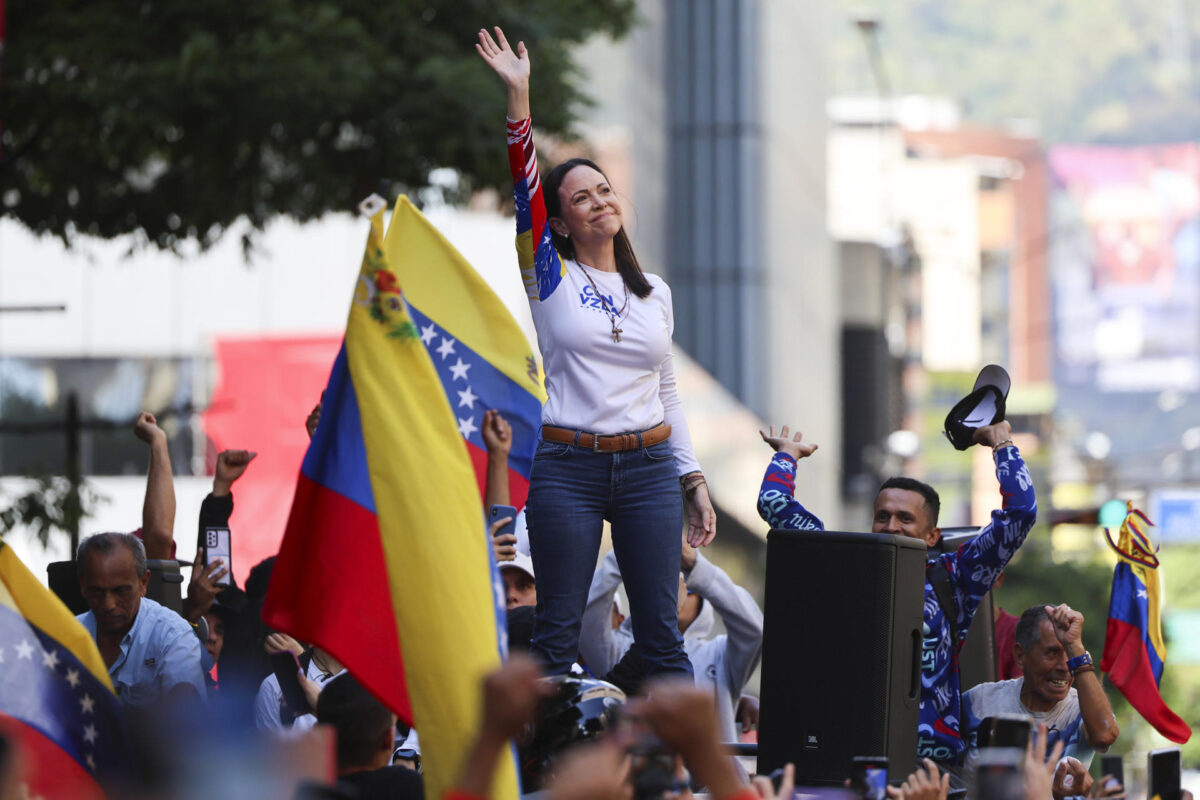
In a video shared on her social media, Machado stated that “in a few weeks, we’ll see each other in Venezuela,” and that Venezuelans are clear about the route and the tasks required to achieve the country’s full freedom. Her use of a white shirt and rosaries around her neck—evoking the civic movement that led to the July 28, 2024 electoral victory, not recognized by the Maduro goverrnment—did not go unnoticed.
The leader of Vente Venezuela said that upon her return, the first task will be to strengthen Venezuelan unity that began with the 2023 opposition primaries and advanced through the grassroots groups, alongside political and social organizations, to secure Edmundo Gonzalez’s landslide electoral victory.
“The return of María Corina is part of the strategy to restore democratic institutional order in Venezuela and of the need for a national agreement. I believe she has understood her historic role in terms of what is required and the need to consolidate internal mobilization around that major agreement,” noted political scientist Raniero Cassoni.
What Does the White House Think?
Aveledo said the opposition leader’s return after more than 80 days outside Venezuela does not necessarily imply an agreement with Washington to guarantee a safe return—as was the case with her departure—but rather a “testing” of the elasticity of the governing system, which has already released political prisoners such as Juan Pablo Guanipa and Freddy Superlano and tolerated protests. He warned that Machado may force Miraflores to define how far its commitment to institutional normalization truly extends.
“The security of this return is a technical and political unknown. If we adhere to a restrictive interpretation of the Amnesty Law, especially under its exclusion clauses, Machado’s legal protection is precarious. However, her decision is an exercise of political agency: she is forcing the system to make a costly decision. The regime must choose between tolerating her presence—thus validating an opening that could slip out of its control—or bearing the immense reputational and diplomatic cost of repressing the figure with the greatest social representativeness in the country,” Aveledo emphasized.
In an interview with NBC on February 12, interim ruler Delcy Rodriguez warned that if Machado returns to Venezuela, she will have to answer for calling for foreign intervention and requesting international sanctions.
Cassoni notes it is also unclear whether the Nobel laureate’s return will be coordinated with the US or has its approval, but he does not see it as isolated from the strategy outlined by Secretary of State Marco Rubio, who has said that after stabilization and recovery, free elections could take place in Venezuela.
Article 9 of the Amnesty Law establishes that “persons who are or may be prosecuted or convicted for promoting, instigating, requesting, invoking, favoring, facilitating, financing, or participating in armed or forceful actions against the people, sovereignty, and territorial integrity” of Venezuela by foreign states, corporations, or individuals are excluded from pardon. From this it follows that politicians like Machado—who faces a criminal investigation for allegedly invoking foreign intervention, according to Chavismo—would not benefit.
The NGO Provea also noted that the annulment of political disqualifications was not included as part of the amnesty, despite proposals made by NGOs to Parliament. Political analysts have little doubt that these decisions are primarily aimed at affecting the opposition leader abroad so that she remains distanced from a presidential candidacy since mid-December.
So far, Trump has gone no further than saying he would like to “include” Machado—whom he met with on January 15 and does not rule out meeting again—in the Venezuelan transition process, a decision that her return could accelerate.
Are Elections Approaching?
The second task, according to Machado, is to finalize the consolidation of a national agreement with political and social organizations and leaders to establish the consensus necessary to ensure governability during the transition process toward a democratic Venezuela. As a third task, Machado called on her followers to prepare “for a new and gigantic electoral victory.”
Aveledo and Cassoni agree that Machado’s presence in Venezuela would not automatically indicate the proximity of new presidential or general elections. Secretary of State Marco Rubio admitted during his speech at the 50th Regular Meeting of Heads of Government of CARICOM in Saint Kitts and Nevis on February 26 that elections legitimizing a governing system are necessary to attract the investments the country needs. However, he once again omitted any timeline for potential voting.
Cassoni adds that a Machado return without reprisals against her would be an important signal of imminent normalcy for such investments.
“Her return implies the return of conflict over the rules of the game. While Delcy Rodríguez’s interim government focuses on managing administrative continuity and economic stabilization, Machado’s presence shifts the focus toward the demand for pluralism. She represents the reminder that stability without legitimacy is a fragile construction,” Aveledo said.
He stressed that “fundamental pieces are still missing” on the board for competitive elections, such as the reinstitutionalization of the Electoral Branch, the legalization of the parties of the Democratic Unitary Platform, and the “dismantling” of the repressive apparatus.
“Machado’s return marks the beginning of a phase of institutionalized pressure, where the demand will no longer be only for public policies or material relief, but for the restoration of the Venezuelan people’s right to decide their own destiny through transparent and plural mechanisms,” Aveledo added.
Before presidential elections, Cassoni points to the renewal of other public powers, including Parliament, from which a national agreement could emerge to facilitate stability for the incoming government.
Marquez Does Not Compete with Machado
For many Venezuelans, it was strange that Machado did not attend Donald Trump’s State of the Union address on the night of February 24, while Enrique Márquez was present.
Senator Rick Scott said his office extended an invitation to the opposition leader to accompany him as his guest at the event, but that the former lawmaker’s team did not respond. Many of Machado’s detractors highlighted this as a setback and applauded the possible positioning of Márquez as a candidate to lead a transition.
Trump mentioned Marquez during the speech and presented him as a “symbol of the liberation of political prisoners,” following his detention in 2025 and release in January 2026.
But in her Sunday message, Machado thanked “the people of the United States, its government, its members of Congress, judges, men and women in the military who risked their lives for Venezuela’s freedom and for the national security of their country and all of the Americas.”
“Marquez’s presence at Trump’s speech, in some way, reaffirmed that a change is taking shape in Venezuela. I think he is more closely linked to what could be a change in the National Electoral Council, the need to renew electoral authorities that generate trust,” Cassoni concluded.
First published in Spanish by Efecto Cocuyo and translated and posted in English by Havana Times.
Read more feature articles here on Havana Times.